
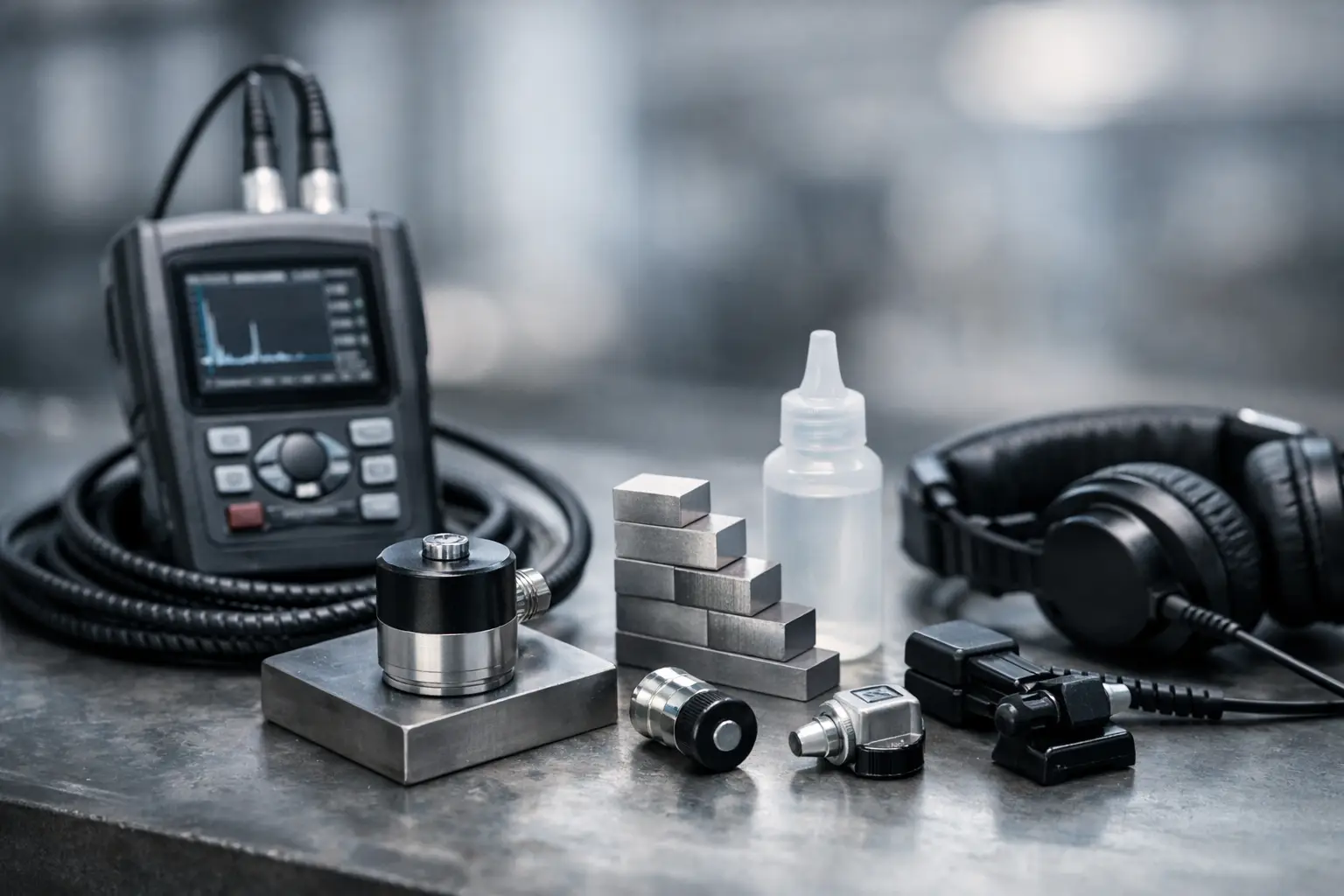

A thickness reading that drifts by half a millimetre can turn a routine corrosion check into a bad call. Most technicians know the gauge itself matters, but in the field, ultrasonic thickness gauge accessories often decide whether the job runs cleanly or turns into rework, missed areas and questionable data.
For corrosion mapping, spot checks and repeat inspections, accessories are not add-ons in the marketing sense. They are part of the measurement system. Probe choice, cabling, couplant delivery, probe holders and encoder-based scanning hardware all change how reliably you can get sound into the part and get repeatable readings back out. If the accessory package is wrong for the surface, temperature, coating condition or access constraint, even a good gauge can become frustratingly inconsistent.
Why ultrasonic thickness gauge accessories matter in practice
On paper, a handheld UT gauge looks simple enough. Put the probe on the surface, apply couplant and take a reading. On actual assets, surfaces are curved, coated, pitted, hot, wet, overhead, cramped or all of the above. That is where accessories stop being optional.
The first issue is repeatability. If one operator uses a small single-element probe on a rough corroded surface and another uses a delay line arrangement better suited to thin wall or coated material, you can end up comparing numbers produced under different conditions. The second issue is speed. A technician can lose a surprising amount of time dealing with poor cable routing, awkward probe handling or couplant that does not suit the temperature and finish of the material. The third issue is equipment strain. When teams try to force one setup across every inspection task, they create wear, rebuild time and bottlenecks.
That trade-off shows up most clearly in service companies. If the same thickness gauge is expected to handle general spot checks one day, encoded corrosion work the next and awkward access vessel work after that, accessory choice becomes part of job planning, not an afterthought.
The ultrasonic thickness gauge accessories worth paying attention to
Probes and transducers
If there is one accessory category that affects results more than any other, it is the probe. Frequency, element size and transducer style need to match the job. A small diameter probe can help with tight geometry and localised corrosion, but it may not give the same stability on broader flat surfaces as a larger contact area. Higher frequencies can improve sensitivity on thinner sections, but rough or attenuative materials may respond better to lower frequencies.
Then there is the coated-versus-uncoated question. If you are measuring through coatings or dealing with mixed asset conditions, the wrong probe setup can waste a lot of time chasing unreliable couplings. For very thin materials, delay lines or specialised transducer arrangements may be needed to separate interface echoes cleanly. For hot surfaces, standard probes may simply not hold up or may drift out of useful operating range.
That is why many operators end up carrying more than one probe option. It costs more up front, but it usually costs less than trying to force a single probe across every inspection condition.
Cables and connectors
Cables get ignored until they cause trouble. A damaged or poorly matched cable can introduce intermittent signal loss, noisy readings or complete downtime in the middle of a job. In workshop conditions that is annoying. On a shutdown, it is expensive.
Field inspection is hard on cables. They get bent around ladders, dragged across plate, pinched in scanner frames and packed into kit boxes while still wet with couplant. Good cable management and the right connector style matter more than people like to admit. Shorter cables can reduce clutter when working close to the gauge, but longer runs may be unavoidable on awkward geometry or when using scanners. It depends on access and how the operator needs to move.
A practical setup keeps spare cables in the kit and avoids using one cable across every application until it fails. That is not overkill. It is basic uptime protection.
Couplant and delivery options
Couplant is simple until surface condition makes it difficult. On smooth ambient-temperature steel, almost any standard couplant will do the job. On vertical surfaces, overhead work, high-temperature inspection or rough corrosion, the couplant choice starts affecting reading quality and workflow.
A thinner couplant may spread well but run off too quickly. A thicker gel may stay put on vertical surfaces but become messy during fast spot measurements. High-temperature couplants extend capability, but they also bring handling considerations and can still have practical temperature limits. If your team is moving between ambient and elevated temperature work, it makes sense to separate those consumables rather than improvising on site.
Even the way couplant is carried matters. Bottles that are easy to squeeze with gloves on and easy to stow in a pouch save more time than most people expect over a full shift.
Probe holders, stands and small handling aids
When inspections move from occasional spot checks to repeated readings across a structured area, handheld consistency becomes harder to maintain. Probe holders, small guide fixtures and basic stands can improve contact angle, reduce operator fatigue and make repeat readings more dependable.
This matters especially on curved surfaces and when access is awkward. A simple handling aid that keeps the probe square to the surface can reduce the temptation to accept unstable readings just to keep the job moving. It also helps newer technicians maintain better discipline while they build experience.
These accessories are not glamorous, but they are often the difference between a setup that works well for ten readings and one that works well for two thousand.
When thickness work needs scanning hardware, not just a gauge
At a certain point, ultrasonic thickness gauge accessories move beyond probe-level items and into scanning hardware. That usually happens when the job is no longer about isolated spot checks. Corrosion mapping, encoded A-scan collection and repeatable coverage over larger areas all benefit from a scanner-based approach.
This is where many inspection teams get caught. They own a capable instrument, but the accessory ecosystem around it is too limited for efficient deployment. Instead of a practical scanner, they improvise with tape marks, hand spacing and operator memory. It can be done, but it is slow, hard to defend and difficult to repeat on the next shutdown.
Modular scanner accessories solve a different problem to a simple handheld kit. They help with encoded movement, probe stability, indexing and positioning. For corrosion work on plate, pipe or awkward weld-adjacent areas, that means more controlled data collection and less dependence on operator feel alone. It is not always necessary for every job, but where traceability and repeatability matter, it is often the better path.
Encoders and position tracking
If you need recorded position with your thickness data, an encoder is no longer a luxury item. It becomes part of the inspection method. Position tracking supports repeat scans, reporting confidence and more reliable follow-up inspections when wall loss trends need to be compared over time.
The trade-off is setup time. Encoded hardware takes longer to configure than a basic handheld reading. For a small number of spot checks, that extra setup may not make sense. For larger corrosion programs, it usually pays for itself quickly.
Frames, wheels and surface-specific scanning attachments
Scanner frames and wheel configurations matter because surfaces are rarely ideal. A flat plate scanner may not behave well on small diameter pipe. A setup that tracks nicely on clean painted steel may struggle on scaling, weld cap transitions or local roughness. Accessories that adapt contact pressure, wheel spacing or probe mounting can make the difference between a scanner that gets used and one that stays in the case.
That is also why modularity matters. If every new job requires a full rebuild of one premium scanner, inspection capacity stalls. Purpose-built accessories and task-specific hardware let crews keep multiple setups ready instead of cannibalising one system for every application.
How to choose accessories without wasting budget
The easiest mistake is buying around the instrument brochure instead of the work mix. Start with the jobs you actually do. If most of your thickness work is corrosion screening on painted carbon steel, buy for that. If your team regularly moves onto hot surfaces, thin wall tubing or small diameter pipe, account for those realities early.
Think in terms of failure points. Where do jobs slow down now? If operators keep fighting poor coupling, the issue may be probe selection or couplant. If readings are fine but throughput is poor, handling aids or scanning accessories may be the answer. If downtime comes from damaged cables and ad hoc setups, invest there first.
It also helps to separate nice-to-have accessories from capacity-building accessories. A spare probe and spare cable usually protect delivery. Encoders and scanners can expand capability. Both matter, but not in the same way.
For many NDT businesses, the smartest approach is not one oversized hardware package. It is a practical accessory ecosystem built around common tasks, with enough duplication to avoid stoppages and enough modularity to adapt without rebuilding everything from scratch. That is the kind of thinking behind PAUT.Tech's approach to inspection hardware more broadly - gear that fits the task, keeps costs under control and works the way field crews actually work.
Good thickness data starts before the first reading. If your accessories suit the surface, the access and the job pace, the gauge has a fair chance to perform properly - and so does the technician holding it.