
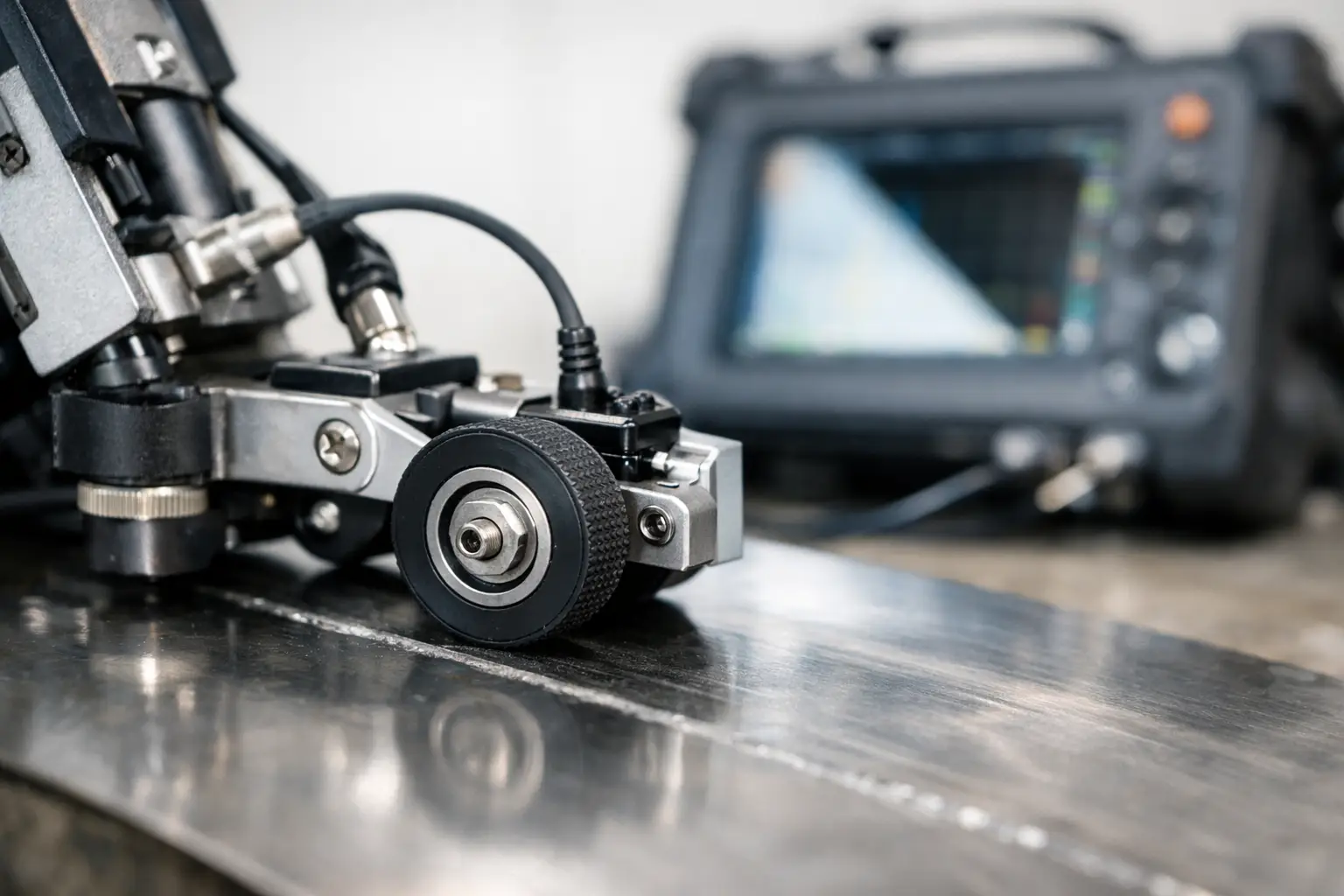

If you have ever had a scan go off the rails halfway along a weld because the wheel started slipping, bouncing or loading up with grime, you already know the ndt encoder wheel is not a minor accessory. It is one of the small components that can quietly ruin good inspection data. In PAUT and ToFD work, where positional accuracy drives sizing, mapping and repeatability, the encoder wheel is doing more than rolling along the surface. It is translating real movement into usable data, and it has to do that reliably in field conditions that are rarely ideal.
That sounds obvious, but in practice the wheel often gets treated as a consumable afterthought. The scanner gets the attention, the probe setup gets checked, and the encoder wheel is only noticed when counts start dropping out or the scan line looks wrong. For technicians working shutdowns, fabrication jobs or corrosion mapping campaigns, that is backwards. A poor wheel choice can create rework, false confidence or wasted time chasing a software problem that is really a mechanical one.
Why the ndt encoder wheel matters so much
An encoder only knows what the wheel tells it. If the wheel diameter is inconsistent, if the tread loses grip, or if the contact pressure changes over the scan, the data stream no longer reflects true travel. That matters on long welds, but it matters just as much on short scans where operators assume error will be negligible.
In PAUT, poor positional tracking can distort C-scan presentation and make repeat scans harder to compare. In ToFD, it can affect the confidence you have in defect location and length. On corrosion work, especially around coatings, curved surfaces or awkward access, wheel behaviour can be the difference between a clean grid and a frustrating patchwork of questionable data.
The practical point is simple. The wheel is part of the measurement chain. Treating it as a generic rolling part usually costs more later.
What makes a good ndt encoder wheel
The right wheel depends on the job, but a few traits matter almost every time. First is consistent traction. A wheel that grips well on one surface and skates on another will make scanner performance unpredictable. Steel plate, painted surfaces, scale, wrapped pipe and warm components all behave differently, so wheel material and tread pattern need to suit the actual surface, not the ideal one.
Second is dimensional consistency. If the wheel wears quickly, deforms under load or carries debris around the circumference, your encoder counts stop matching real travel. That may only show up as a few millimetres over a short run, but over repeated scans or encoded raster work it adds up.
Third is stability. A wheel that chatters over weld cap, coarse coating or pitting can produce irregular motion even if the scanner frame is sound. In the field, the issue is rarely one isolated component. It is the interaction between wheel material, scanner mass, spring pressure, surface condition and scan speed.
That is why there is no universal best option. There is only the best fit for a given inspection task.
Material choice is not just about durability
A harder wheel may last longer and hold diameter better, but it can also lose grip on smooth or contaminated surfaces. A softer wheel may track better on difficult surfaces, though it can wear faster and may be more affected by heat or debris pickup. For many inspection teams, the right balance is not maximum life. It is predictable performance across the sort of surfaces they scan most often.
This is where field reality matters. A workshop demo on clean plate tells you very little about what happens on a live plant job with surface rust, couplant, paint overspray and limited access. An engineer-led design approach usually recognises that early, because the wheel has to work where technicians actually earn their keep.
Wheel size changes more than resolution
People often focus on counts per millimetre, but wheel diameter also affects how the scanner behaves mechanically. A larger wheel may bridge minor surface variation better and roll more smoothly over roughness. A smaller wheel can package more neatly into compact scanners and tight access setups, but may be more sensitive to local surface condition.
Neither is automatically right. If you are scanning narrow geometries, small bore pipe or confined welds, compactness can matter more than forgiving ride quality. On longer, straighter scans, smoother travel may be the bigger win.
Common failure points in the field
Most encoder wheel problems are not dramatic. They show up as subtle inconsistency, which is exactly why they waste time. A bit of slip at the start of the scan, slight bounce over cap profile, a tread that picks up contamination, or a wheel mount that develops play - each one can degrade positional confidence without producing an obvious equipment failure.
Wear is the obvious issue, but contamination is nearly as common. Couplant, dust, grinding residue and coating debris can change effective diameter or reduce grip. If the wheel runs close to weld prep dust or corrosion products all day, performance can shift during the job even when the wheel looked fine at setup.
Alignment also gets overlooked. A good wheel in a poor mounting arrangement still gives poor results. If the wheel is not loaded properly against the surface, or if it is being pulled sideways through the scan because the scanner geometry is fighting the weld path, the encoder signal may be technically active but practically unreliable.
Matching the wheel to the scanner and application
The encoder wheel should be considered alongside the whole scanner setup, not selected in isolation. Contact pressure, frame stiffness, wheel position and cable management all influence tracking. A wheel that works well on a corrosion scanner with broad support may behave differently on a narrow weld scanner with a more concentrated load path.
This is one reason modular hardware has real value. If your operation is constantly rebuilding one scanner for every task, the wheel setup tends to become a compromise. It might be acceptable on several jobs without being particularly good on any of them. For owner-operators and smaller NDT businesses, that usually means more adjustment time and more wear on the same components.
Purpose-built scanning setups reduce that compromise. Different jobs place different demands on the wheel. A pipe scanner, a ToFD carriage and a corrosion mapping rig do not all ask for the same thing, even if they share encoder logic.
Weld scanning versus corrosion mapping
On weld scanning, especially in PAUT and ToFD, directional stability and repeatability along a defined path are usually the priority. The wheel needs to hold line and maintain clean positional feedback over a relatively narrow scan track. Surface transitions near the weld cap, heat tint and minor geometry changes all test how well it tracks.
On corrosion mapping, the wheel may have to tolerate broader area scanning, longer run lengths and more varied surface condition. Here, smooth travel and resistance to contamination can become more important than compact packaging. If the job involves coated surfaces or rough parent material, wheel behaviour can shift quickly if the material choice is not suited.
When cheaper is false economy
There is nothing wrong with wanting affordable hardware. Most inspection businesses need gear that earns quickly and can be deployed across real jobs without premium-brand pricing. But there is a difference between cost-effective and under-engineered.
A low-cost wheel that wears unpredictably, slips on common surfaces or introduces doubt into encoded data is not saving money. It is moving cost into downtime, rescans and operator frustration. The smarter approach is practical value - a wheel that is affordable, replaceable and designed around actual inspection conditions rather than catalogue specs alone.
That is where specialist suppliers tend to outperform generic parts sourcing. When the hardware is designed by people who understand PAUT and ToFD field use, the trade-offs are usually clearer. PAUT.Tech works in that space - practical scanner hardware built around inspection tasks rather than prestige branding.
How to get better performance from any encoder wheel
Good hardware helps, but handling matters too. Keep the wheel clean during the shift, especially on dirty or coated jobs. Check for tread wear before positional error becomes visible in the data. Confirm mounting security and free rotation, and pay attention to contact pressure after any scanner adjustment.
It is also worth validating wheel performance on the actual surface before committing to production scans. A short controlled run can tell you a lot about grip and repeatability. That few extra minutes at setup is usually cheaper than explaining inconsistent encoded data later.
If you are running mixed work, stock more than one wheel type where possible. That is not overkill. It is the same logic as keeping more than one wedge or scanner configuration. The job changes, so the hardware should be allowed to change with it.
The ndt encoder wheel is a small part, but it has a direct say in whether your scan data is trustworthy. If your encoded setup is only as good as its weakest mechanical component, this is one place worth getting deliberate. The best wheel is not the fanciest one. It is the one that keeps counting properly when the surface, schedule and site conditions stop being polite.