
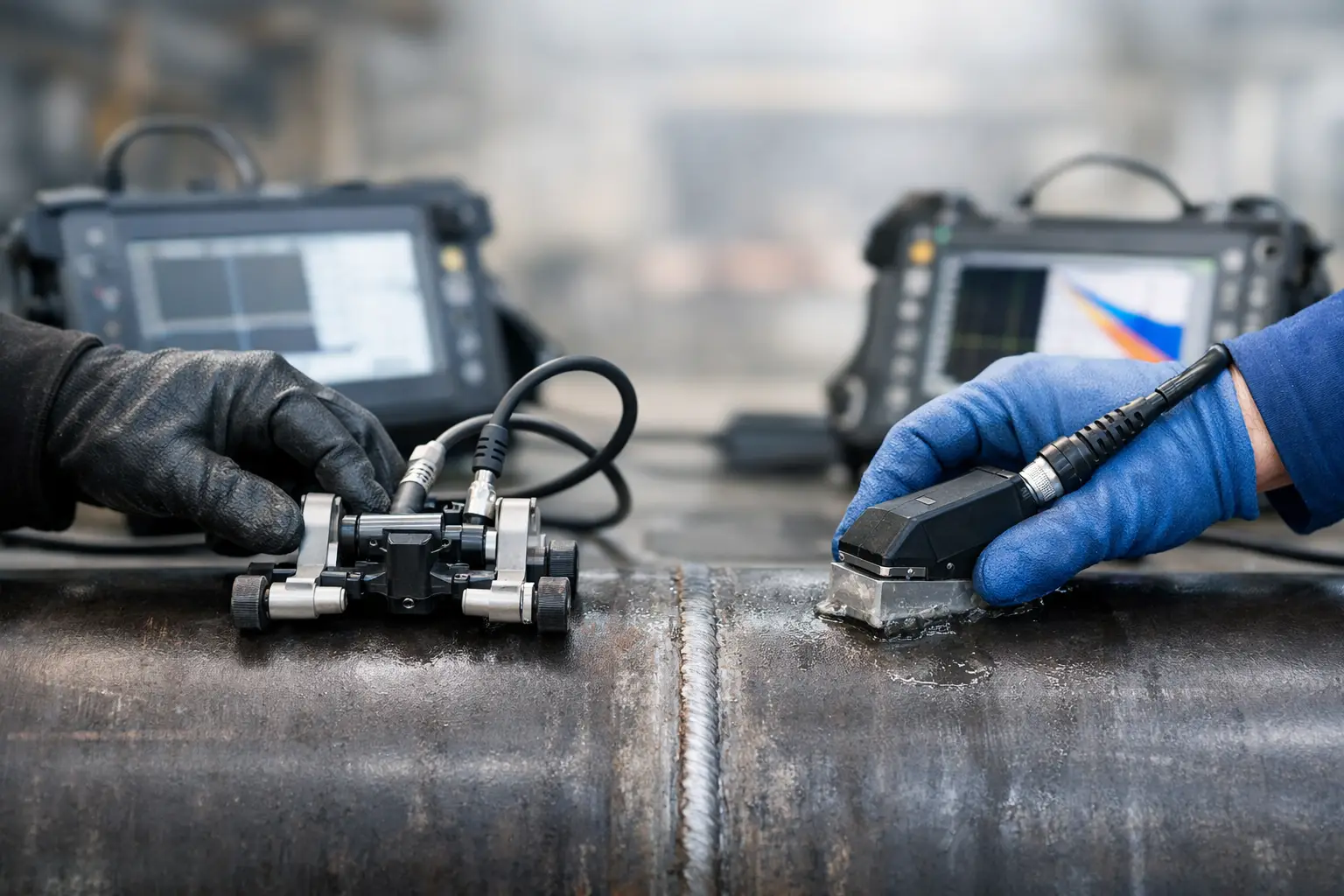

A lot of inspection decisions get made too late - after the scanner is built, the wedges are on, and someone realises the technique does not suit the weld. Knowing when to use TOFD vs PAUT matters well before that point, because the right choice affects coverage, sizing confidence, scan speed and how much rework your crew wears on site.
When to use TOFD vs PAUT
The short answer is that TOFD is often the stronger option when you need reliable through-wall sizing of planar weld defects and you have suitable geometry, access and surface condition. PAUT is usually the better choice when the weld profile is complex, access is limited, geometry is variable, or you need more flexibility in beam steering and coverage.
That sounds simple, but in practice the choice depends on what you are trying to find, how the component can be scanned, and what the procedure or code will accept. Most experienced operators know there is no universal winner. TOFD and PAUT solve different problems well, and on many jobs they work best together rather than as competitors.
What TOFD does well
TOFD is particularly strong on defect detection and sizing where diffraction from crack tips gives you clear positional information. On butt welds with decent access either side of the cap, it can provide fast scans and very good height sizing for lack of fusion, cracks and other planar indications. When the weld prep, thickness and surface condition are suitable, TOFD gives you a very efficient inspection method with a well-understood data set.
That is one reason TOFD remains a preferred technique on many production welds. If you are scanning repeated welds of similar geometry, the setup is stable and the interpretation workflow is mature. For service companies doing volume weld inspection, that efficiency matters.
TOFD also has value because it is less dependent on reflected amplitude than conventional pulse-echo style methods. You are reading diffracted energy from flaw extremities, not simply waiting for a strong reflection to come back at the right angle. For sizing vertical extent, that can be a major advantage.
Where TOFD starts to struggle
TOFD is not magic. The dead zones near the scanning surface and back wall can limit sensitivity to defects in those regions. Cap shape, root profile, coarse grain structure and difficult surface condition can all make interpretation harder. Thin sections can also reduce the practical usefulness of TOFD, especially where separating lateral wave, back wall and defect signals becomes messy.
Geometry matters as well. If you do not have enough room to position probes either side of the weld properly, TOFD becomes awkward fast. The method also relies on consistent probe separation and stable coupling. On rough field welds, painted surfaces, tight nozzle configurations or restricted access around supports, that neat textbook setup can fall apart.
That is often the point where PAUT earns its keep.
What PAUT does well
PAUT gives you control. You can steer, focus and sequence beams to suit the weld bevel, thickness and likely defect zones. That flexibility makes PAUT a practical choice for complex weld geometries, branch connections, nozzle welds, dissimilar thickness joints and situations where you cannot physically set up a traditional TOFD arrangement.
For detection work, PAUT is very effective because you can tailor your focal laws to the inspection problem. If you expect side wall lack of fusion, toe cracking or root-related discontinuities, you can design the scan to interrogate those areas directly. That matters on jobs where the defect mechanism is known and the inspection needs to target it.
PAUT is also often easier to adapt when access is only available from one side or when scanner arrangements need to stay compact. In the field, that can be the difference between getting the job done properly and spending half the shift rebuilding hardware to make an impractical setup fit.
Where PAUT has trade-offs
PAUT is flexible, but it asks more of the procedure and the operator. Beam modelling, focal law selection, coverage justification and data interpretation all need to be done properly. If the setup is poor, the pretty sectorial display can give false confidence.
Sizing can also be technique-dependent. PAUT can size defects well, but the result depends on beam angle, aperture, focal law design and the nature of the reflector. For some planar flaws, especially where through-wall height is the key acceptance criterion, TOFD may still provide more straightforward sizing confidence.
There is also the real-world issue of hardware. A scanner that works beautifully for one weld does not always convert efficiently to the next. On busy sites, constantly reconfiguring one scanner across multiple jobs slows the crew down and adds wear where you do not need it.
Defect type should drive the choice
If the main concern is planar cracking or lack of fusion in a reasonably accessible butt weld, TOFD deserves serious consideration. It is efficient and often strong on height sizing. If the concern is broader coverage across varying defect orientations, awkward bevel geometry or uncertain flaw position, PAUT usually gives you more options.
Volumetric defects can also shift the balance. TOFD can detect them, but it is not generally the first choice if your main objective is characterising porosity or slag distribution. PAUT is often more practical there because you can interrogate the weld volume from multiple angles and build a fuller picture of response.
This is where procedure intent matters. Are you trying to screen for rejectable planar flaws, size known indications, replace radiography, or support engineering critical assessment? Those are not the same job, and they should not default to the same technique.
Access, surface and scanner practicality
A lot of technique selection gets talked about in terms of signal behaviour, but the field decision is often mechanical. Can you get the probes where they need to go? Can the scanner track consistently? Will the weld cap, coatings, clamps or adjacent geometry interfere with the run?
TOFD generally likes stable, symmetric access around the weld. PAUT can be packaged into more compact and task-specific scanner arrangements. For contractors handling mixed work - pipe one day, plate the next, then corrosion mapping on another asset - purpose-built scanner setups reduce rebuild time and keep inspections moving.
That practical side is often underestimated. A technically ideal technique is not much use if the hardware arrangement is slow, fragile or awkward on site. Good inspection planning means choosing a method that suits both the metallurgy and the mechanics of the job.
When TOFD and PAUT work best together
On many critical welds, the smartest answer to when to use TOFD vs PAUT is both. TOFD can provide strong detection and through-wall sizing for planar indications, while PAUT adds coverage in dead zones, interrogates difficult geometry and helps with characterisation from different angles.
This combined approach is common for a reason. Each method covers a weakness in the other. TOFD helps where sizing confidence is needed. PAUT helps where geometry, access or coverage complexity would otherwise leave questions unanswered.
If the job carries high consequence or the acceptance criteria are tight, running both techniques can reduce argument later. It gives the client a stronger technical basis for decision-making and gives the operator more confidence in what the data is actually saying.
Code, procedure and client requirements
The right technical choice still has to fit the written requirement. Some jobs specify one method. Others permit multiple techniques but set qualification rules that favour one over the other. Before committing to hardware and scan plans, check what the governing code, procedure and client actually require.
That includes calibration blocks, sensitivity setup, scan coverage and acceptance criteria. A method that is technically suitable but procedurally unsupported can create more grief than it saves. On shutdown work, nobody wants to debate a technique choice after the scaffold is up and the permit clock is running.
A practical way to decide on site
Start with the weld type, thickness and likely defect mechanism. Then look at access, surface condition and whether the scanner arrangement will be stable and repeatable. After that, consider whether the job needs detection, sizing, characterisation, or all three.
If the weld is a straightforward butt joint with good access and planar flaw sizing is the priority, TOFD is often the efficient choice. If the geometry is awkward, access is restricted, or the inspection needs tailored beam control, PAUT is usually the better fit. If the stakes are high and the limitations of either method could affect confidence, use both.
That is the practical mindset behind good NDT work. Technique selection is not about defending a favourite method. It is about matching the physics, the hardware and the job conditions so the data stands up when it matters.
For crews trying to keep inspections moving without rebuilding the same scanner for every task, that decision starts earlier than the scan itself. Choose the method that fits the weld, then make sure the scanner setup fits the day.