
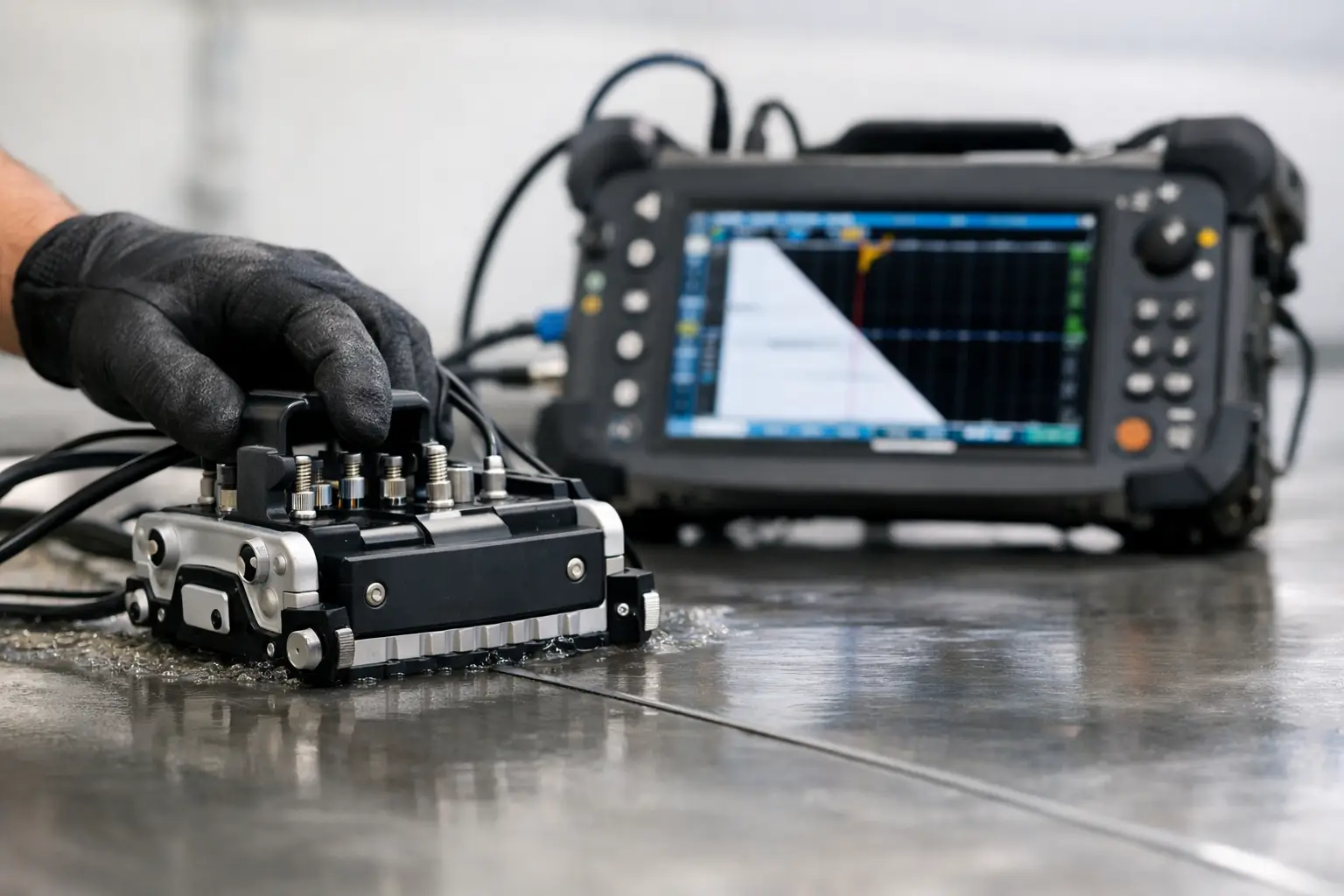

If you have ever had to explain to a client why a phased array setup needs more than just a probe and instrument, this is usually where the scanner enters the conversation. How does a PAUT scanner work? In practical terms, it gives the probe controlled, repeatable movement over the test surface while feeding positional data back to the instrument so your scan is not just sound data, but sound data tied to location.
That sounds simple enough on paper. In the field, though, scanner performance has a direct effect on data quality, scan coverage, repeatability, and job time. A good PAUT scanner is not there to make the setup look more sophisticated. It is there to help you collect inspection data you can trust and reproduce.
How does a PAUT scanner work in practice?
At its core, a PAUT scanner is a mechanical carriage that moves one or more probes along a defined path. That path might be along a weld cap, around a pipe circumference, or across an area being checked for corrosion mapping. The scanner holds the probe assembly in position, keeps contact with the surface, and tracks movement with an encoder.
As the operator pushes or pulls the scanner, the encoder measures distance travelled. That position information is sent to the PAUT instrument, which matches each A-scan or focal law data set to a specific location. When the instrument builds a B-scan, C-scan, S-scan, or encoded strip scan, it is using that encoder input to place the ultrasonic information where it belongs.
Without encoded movement, you can still perform manual spot checks or unencoded scans, but repeatability drops away quickly. It becomes harder to prove full coverage, harder to return to an exact indication, and harder to compare one pass with another. That is why scanners matter, especially when the job calls for traceable records or procedural compliance.
The main parts of a PAUT scanner
Most PAUT scanners follow the same basic logic even if the frame design changes. You have a body or carriage, wheels or magnetic rollers for movement, a probe holder, an encoder, and some form of adjustment system for probe position and pressure.
The carriage gives the whole assembly structure. On a flat plate weld scanner, that might be a compact frame designed to sit either side of the weld. On a pipe scanner, it may be a banded or chain-driven arrangement that keeps the scanner aligned around the circumference. In both cases, the aim is the same - stable travel and consistent geometry.
The probe holder keeps the wedge and probe where they need to be. That sounds obvious, but probe alignment is one of the first places poor scanner design causes trouble. If the holder allows too much movement, or if adjustment is slow and fiddly, setup time increases and scan consistency suffers. In real inspection work, especially when you are changing from one weld size or diameter to another, ease of adjustment matters nearly as much as the scan itself.
Then there is the encoder. This is the part that turns movement into usable location data. It usually works off a wheel rotation or similar mechanical movement, generating pulses as the scanner travels. The instrument counts those pulses and converts them into distance. If the encoder slips, skips, or loses contact, your positional data becomes questionable even if the ultrasonic signal quality is fine.
What the scanner is actually doing during a scan
A PAUT scanner does not create the ultrasonic beam. That job belongs to the instrument, probe, and focal laws. What the scanner does is control the physical side of the inspection so the beam is applied consistently across the area of interest.
Take a typical weld inspection. The scanner keeps the probe at a set offset from the weld centreline and allows it to travel at a fairly constant path along the weld length. If you are using one probe each side of the weld, or a combined PAUT and ToFD setup, the scanner keeps those relationships fixed while the encoder logs travel distance.
That controlled movement gives you three big advantages. First, coverage is more consistent because the probe is not wandering off-line. Second, data is easier to interpret because the scan has reliable positional reference. Third, you can repeat the scan later with far less guesswork, which matters when indications need verification or when clients ask for comparison over time.
This is also why scanner fit matters. A scanner that is excellent on a smooth fabrication bench may be less useful on a coated pipe, a hot workpiece, or a weld with awkward cap profile. Mechanical stability and practical adaptability are often the difference between a scan that works well in procedure and one that works well on site.
Why encoders matter more than many people think
If you strip the idea right back, a scanner is only as useful as its ability to tell the instrument where the probe has been. That makes the encoder central to the whole setup.
When the encoder is working properly, the instrument can create a position-based record of the scan. That lets you size and locate indications with more confidence, document coverage, and return to a specific point if needed. For code work, procedure qualification, or any job where reporting matters, this is not a nice extra. It is part of producing defensible inspection data.
The trade-off is that encoder accuracy depends on the scanner maintaining proper contact and traction. On rough surfaces, tight radii, dirty steel, or awkward orientations, wheel slip can become an issue. That does not mean the scanner is wrong for the job, but it does mean the operator needs to understand the limitations and choose hardware that suits the surface and scan path.
How scanner design changes by application
Not every PAUT scanner works the same way because not every inspection problem is the same.
For linear weld scanning on plate or pipe seams, compact two-wheel or four-wheel scanners are common because they are quick to deploy and easy to run along a straight path. For circumferential pipe welds, chain scanners or band scanners are often the better option because they maintain alignment around the pipe and support full circumference travel. For corrosion mapping, wider-area encoded scanners may be used to sweep across a grid rather than a single weld line.
That is where many inspection teams lose time with generic hardware. One scanner can sometimes be adapted to cover multiple tasks, but constant rebuilding, reconfiguring, and swapping brackets creates downtime and wear. In practice, purpose-built scanners often make more operational sense, especially for crews juggling weld jobs, pipe work, and corrosion work across the same week.
Setup quality still drives the result
Even the best scanner will not rescue a poor setup. Probe index offset, wedge alignment, surface condition, couplant management, and cable routing still matter. The scanner improves consistency, but it does not remove the need for competent setup and verification.
A common mistake is to think encoded scanning automatically means accurate scanning. It does not. If the probe is misaligned, if the wedge is lifting, or if the scanner is tracking poorly relative to the weld centreline, the data will still reflect those problems. The scanner gives you control, not immunity.
That is also why simple, field-friendly hardware tends to perform well. If adjustment points are clear, probe mounting is secure, and the frame is suited to the job, technicians spend less time fighting the mechanics and more time checking the actual inspection variables.
Where a PAUT scanner saves time and money
The value of a scanner is not limited to technical quality. It also affects productivity.
Repeatable movement speeds up scanning, reduces rescans, and makes it easier to hand a job from one operator to another. It can also reduce strain on probes, wedges, and cables because the assembly is properly supported rather than dragged manually across the surface. Over time, that matters.
For smaller NDT businesses and owner-operators, there is another practical point. If your whole workflow depends on one expensive scanner being rebuilt for every new application, that scanner becomes a bottleneck. Having task-specific options available is often the more efficient approach. It is one reason businesses like PAUT.Tech focus on modular, job-fit hardware rather than treating one scanner as the answer to everything.
What to look for in a scanner
If you are deciding what scanner suits your work, the first question is not which one has the most features. It is whether the scanner matches the actual inspection geometry, surface condition, and reporting requirement.
Look at how the probe is mounted, how easy it is to adjust offsets, how stable the encoder contact is, and how much effort is involved in changing from one job to the next. A scanner that saves ten minutes on every setup can be more valuable than one with extra complexity you rarely use.
For most technicians, the best scanner is the one that tracks properly, holds position, survives site use, and does not waste time. Fancy design means very little if the frame is awkward on real welds or ends up sitting in the ute because no one wants to rebuild it again.
A PAUT scanner works by giving your ultrasonic data a physical path and a positional record. That is the real job - turning probe movement into repeatable, usable inspection information. When the hardware suits the task, everything downstream gets easier, from acquisition to interpretation to reporting. And that usually shows up first not in the spec sheet, but on the job when the scan runs clean and the data makes sense.