
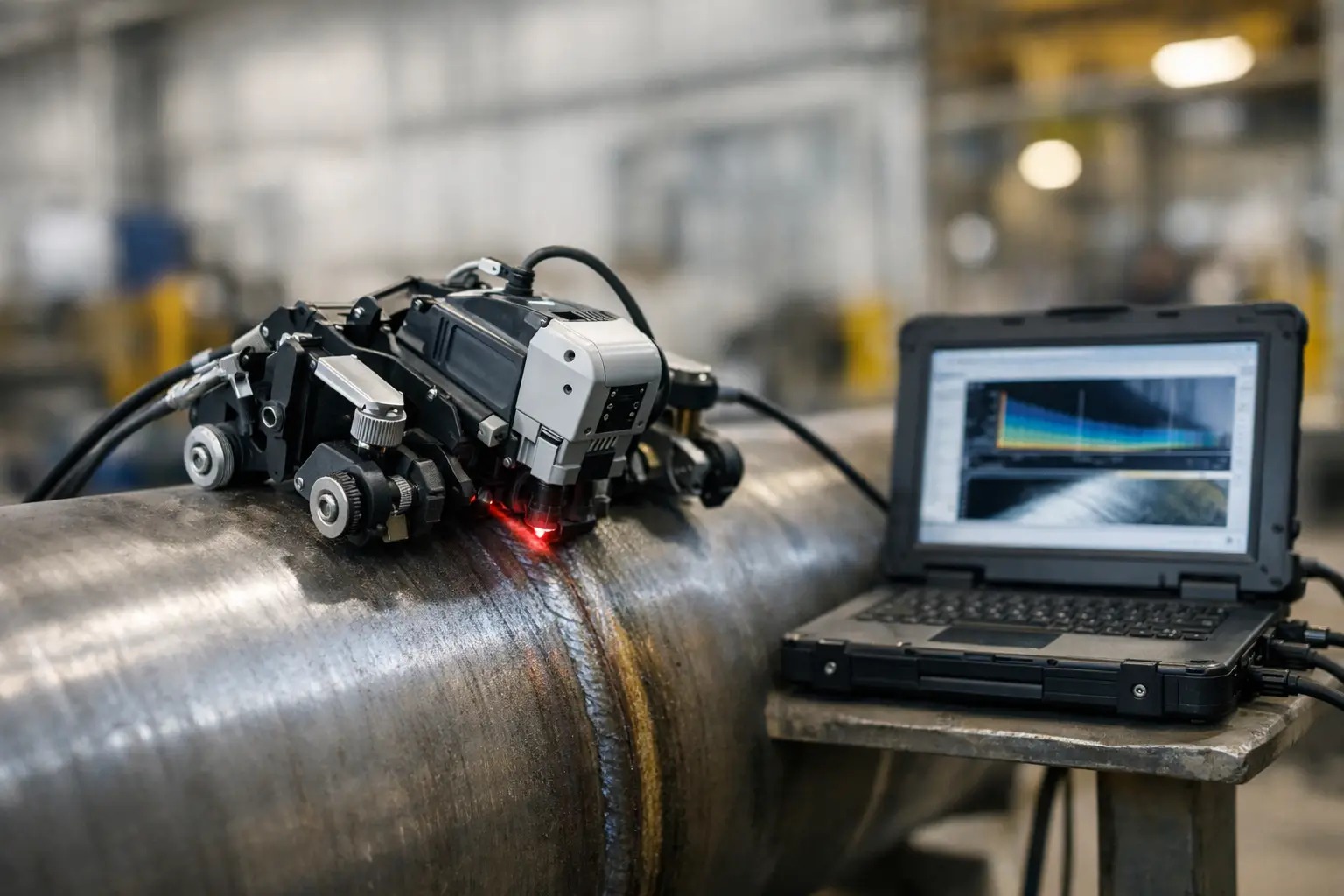

Anyone who has spent a morning rebuilding a scanner just to suit a different pipe size knows the real question is not simply what is the best scanner for pipe weld inspection. It is which scanner will get the weld scanned accurately, repeatably and without turning setup into the longest part of the job.
That distinction matters. In pipe weld inspection, scanner choice affects more than image quality. It changes deployment time, encoder reliability, probe stability, access on cramped jobs, and how much wear your hardware cops over a month of field work. For most NDT teams, the wrong scanner does not fail in a dramatic way. It just slows everything down, adds fiddly adjustments, and creates one more variable when you are trying to produce clean data under pressure.
What the best scanner for pipe weld inspection really means
There is no single scanner that wins every pipe weld job. A small-bore line in a fabrication shop, a large process pipe in a refinery, and a shutdown job with limited clearance all ask for different things.
The best scanner for pipe weld inspection is usually the one that matches the inspection method, pipe diameter range, access conditions and production pace. If you are running PAUT only, your needs may be simpler than a combined PAUT and ToFD setup. If you are scanning the same weld type all week, a dedicated configuration often beats a highly adjustable system. If your team handles mixed work, modularity starts to matter more than having one premium scanner that tries to do everything.
That is where many buying decisions go wrong. People compare scanners as if they are buying a single piece of lab equipment. In practice, they are buying field hardware that has to survive transport, quick changeovers, rough surfaces and operators who do not have time for endless reconfiguration.
Start with the job, not the catalogue
Before comparing brands or accessories, define the actual job envelope. Pipe diameter is the obvious starting point, but it is not enough on its own.
Wall thickness influences probe choice and wedge arrangement. Surface condition affects wheel traction and magnetic stability. Access around the circumference can rule out bulkier frames. Required scan coverage changes whether a compact single-sided arrangement is enough or whether you need a more elaborate multi-probe setup.
Then there is the procedure itself. A scanner suited to encoded PAUT raster work may not be ideal for simultaneous PAUT and ToFD weld inspection. Likewise, a unit that handles straight runs well might become awkward around clamps, supports or nearby branch connections.
Good scanner selection is less about headline capability and more about the fit between the hardware and the actual inspection routine.
The features that matter in the field
Encoder performance sits near the top of the list. If the encoder slips, chatters or loses consistency over dirty or curved surfaces, your data suffers no matter how good the instrument is. Reliable positional encoding is not a luxury feature. It is fundamental.
Probe and wedge stability matter just as much. On pipe welds, especially where profiles vary slightly or coating removal is uneven, stable contact is what keeps your scan repeatable. A scanner that looks flexible on paper can still be frustrating if the probe holders move too easily or need constant adjustment.
Frame size and mechanical simplicity are often underrated. A scanner with fewer unnecessary parts is usually easier to deploy and maintain. Technicians generally do not need more adjustment points. They need the right ones, in the right places, with enough rigidity to stay put once set.
Magnetic hold is another area where trade-offs appear. Strong magnetic adhesion improves tracking and confidence on vertical or awkward pipe positions, but too much drag can make long scans harder, particularly on rough surfaces. The balance depends on the job and the operator.
Weight also deserves attention. Heavy scanners can feel solid, but they are not always better. If the team is moving from weld to weld all day, lighter hardware reduces fatigue and speeds up handling. That is one reason purpose-built scanner design has become more attractive than oversized all-in-one systems.
Why one scanner is rarely the best answer
A common assumption in smaller NDT businesses is that one expensive scanner should cover every job. It sounds efficient until the same scanner is being rebuilt for different diameters, probe spacings and methods several times a week.
That approach creates hidden costs. Setup time expands. Components wear faster. Operators become reluctant to disturb a working configuration for the next task. When multiple crews need encoded scanning at the same time, one scanner becomes a bottleneck.
For many service companies, the better answer is not chasing a single flagship unit. It is using task-specific scanners that are affordable enough to deploy across more than one job type. A dedicated pipe scanner for routine weld work, for example, can save more time over a year than a larger system that spends half its life being reconfigured.
This is where practical design matters more than prestige. Hardware built around common pipe inspection tasks, with modular accessories and straightforward adjustments, often delivers better operational value than systems designed to impress in a brochure.
Best scanner for pipe weld inspection by use case
Repetitive production welds
If your work is mainly repetitive fabrication or production welding across a narrow diameter range, simplicity should win. You want a scanner that sets up quickly, holds probe alignment, and runs reliably day after day. Excess adjustability is usually a disadvantage here because it adds opportunities for drift and operator error.
Mixed service work
For contractors moving between jobs, versatility becomes more important. The scanner should handle a sensible diameter range, adapt to different probe and wedge combinations, and pack down without becoming a puzzle every time it comes out of the case. In this environment, modular hardware earns its keep.
Tight access and shutdown conditions
On shutdowns and congested plant, compactness matters. A scanner might perform well on an open spool in the workshop but become awkward once insulation clearance, adjacent pipework or support steel enters the picture. Low-profile designs and fast mounting can make the difference between getting the scan done efficiently and fighting the hardware all shift.
Higher-end encoded procedures
If your procedure calls for more complex PAUT and ToFD arrangements, scanner rigidity and repeatability become critical. You need dependable probe positioning and a frame that stays consistent through the scan. This is not the place to compromise on mechanical control, but that still does not mean the most expensive option is automatically the best fit.
Cost matters, but not in the way people think
Price is usually discussed as purchase cost alone. In reality, the more useful question is what the scanner costs your operation over time.
A cheap scanner that needs constant adjustment, slips under load or cannot adapt to your common jobs is expensive in practice. On the other hand, a well-designed, fit-for-purpose scanner at a sensible price can expand your capacity because you can afford to keep more than one configuration ready.
That is a major operational advantage. Instead of stripping one scanner down for every new task, teams can keep dedicated setups available. Less rebuild time means faster mobilisation, lower wear on components, and fewer delays when multiple jobs overlap.
For that reason, the best scanner for pipe weld inspection is often the one that improves workflow, not the one with the highest spec sheet.
Questions worth asking before you buy
Ask how long it takes to change from one diameter range to another. Ask whether the probe holders are stable under real field conditions, not just on a bench. Ask how the encoder performs on rough or slightly inconsistent surfaces. Ask what happens when you need a replacement part quickly.
Also ask whether you are buying versatility you will actually use, or complexity you will simply tolerate. Plenty of scanners can be made to fit many jobs. Fewer are genuinely pleasant to use across those jobs.
That distinction tends to separate hardware designed by marketers from hardware designed by people who have actually spent time scanning welds.
A practical way to choose
If you are trying to narrow options, start with your most common pipe weld application and choose for that first. Not the rare edge case. Not the one shutdown every eighteen months. The work that pays the bills most weeks.
Then look at whether a second, more specialised scanner would solve the remaining jobs more efficiently than forcing one platform to cover everything. For many inspection businesses, that is the point where the numbers start to make sense. PAUT.Tech has built much of its approach around that exact reality - practical scanner hardware that lets teams run fit-for-purpose setups without tying up capital in one overburdened unit.
The best scanner is the one that fits the weld, the method and the pace of your work without turning setup into a separate project. If a scanner helps your crew get on pipe faster, hold alignment properly and produce repeatable encoded data with less mucking around, you are looking in the right place.