
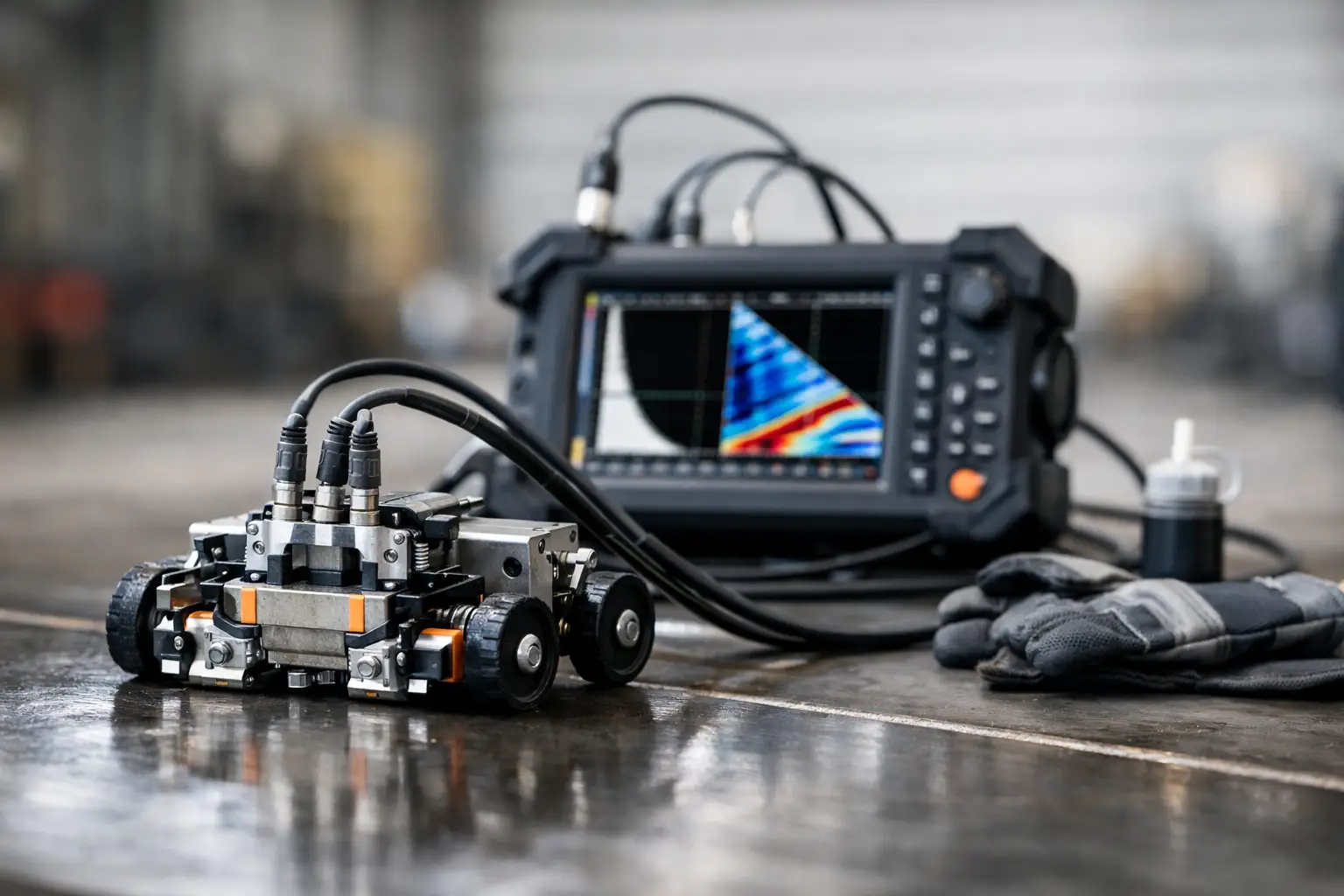

When a crew is held up because the only scanner on site is still set up for the last weld, hardware stops being a purchasing decision and becomes an operational problem. That is exactly why a guide to PAUT scanner hardware needs to start with the job, not the catalogue. In the field, scanner choice affects setup time, repeatability, wear on gear, and how many inspections you can actually complete in a shift.
Phased Array Ultrasonic Testing hardware gets talked about as if one scanner should cover every application. In practice, that usually means compromise. A scanner built for one task can often be adapted for another, but every adaptation costs time and introduces more opportunity for poor alignment, cable strain, encoder issues, or a setup that works on paper and fights the technician all day. Good hardware is not the most complex option. It is the option that suits the scan plan, the surface condition, and the pace of the job.
What this guide to PAUT scanner hardware should help you decide
Most technicians are not looking for theory. They want to know whether a scanner will track properly, whether it will fit around the weld cap, whether it can carry the probe arrangement without flex, and whether the encoder will hold up in service. Those are the questions that matter because they affect data quality and time on tools.
A sensible hardware decision usually comes down to four things: the geometry you are scanning, the probe and wedge arrangement, the required positional accuracy, and how often that setup will be repeated. If you are regularly moving between butt welds, circumferential pipe work, corrosion mapping and ToFD, trying to stretch one premium scanner across all of it can become an expensive bottleneck.
Start with the application, not the scanner
The fastest way to choose the wrong hardware is to shop by brand tier or by how universal the frame claims to be. Start with the inspection task.
For weld inspection, the scanner has to hold the probes with stable pressure and correct spacing while maintaining a clean, repeatable travel path. Flat plate welds, nozzle welds and pipe girth welds all ask different things from the frame. A flat scanner that behaves well on plate may be awkward on smaller diameter pipe. A pipe scanner with enough adjustment for large variation can also become heavier and slower to configure for simple repeat jobs.
For corrosion mapping, the priorities shift. Coverage, consistent indexing and encoder reliability become more important than carrying a complex multi-probe arrangement. The hardware needs to move smoothly over coatings, scale and local surface variation. If the scanner catches, chatters or loses contact, the data will show it.
ToFD also changes the hardware requirement. Probe separation, symmetry and stable travel are less forgiving here. If the frame allows movement or drift in the probe holders, setup confidence drops quickly. That does not always mean expensive hardware. It does mean hardware designed around the technique rather than forced into it.
The core parts that matter most
A scanner frame is only one part of the system. Good PAUT scanner hardware is really the combination of frame, wheels or magnetic drive, probe holders, wedges, encoder and cable management working together.
The frame needs enough stiffness to keep the probes where you set them. If it twists under load or flexes on uneven surfaces, your scan can still run, but repeatability suffers. Lightweight is useful for access and transport, but not if it comes at the expense of stability. There is always a trade-off.
Probe holders deserve more attention than they usually get. Adjustment should be clear and repeatable, not fiddly. On a real job, technicians are often changing wedges, offset, separation or index position under time pressure. If a holder is difficult to fine-tune, setup errors creep in. If it cannot cope with your preferred wedge styles, the scanner may technically work while still becoming a nuisance.
Encoders are another make-or-break component. A scanner with a poor encoder is not a cheap scanner. It is a scanner that creates rework. The encoder should provide reliable positional feedback without slipping or dropping out when surface conditions change. Mounting matters too. If the encoder is exposed to knocks or mounted in a way that encourages misalignment, you will feel it in the data and in the maintenance.
Cable routing also matters more than many buyers expect. Loose cables catch on edges, drag the scanner off line and wear connectors. Simple, sensible cable management reduces that risk. It is not glamorous, but it is part of what makes a scanner practical.
Modularity is useful, but only up to a point
Modular hardware sounds like the answer to every inspection problem. Sometimes it is. Sometimes it just means more parts to keep track of and more setup time before the first scan starts.
The right level of modularity depends on your workload. If you regularly handle varied jobs with different probe arrangements, modular scanner hardware can save money and reduce the need to buy entirely separate systems. You can reconfigure holders, wheel sets and accessories to suit the work. That flexibility has real value.
If your work is repetitive, too much modularity can become overhead. A dedicated scanner that stays assembled for a common weld type is often the better business decision. It reduces rebuild time, minimises wear from constant reconfiguration and keeps your operators moving. For many inspection businesses, the smartest setup is not one scanner that does everything. It is a small ecosystem of purpose-built hardware that covers the jobs you actually do.
Choosing hardware for field conditions
This is where brochure claims usually fall apart. Scanner hardware might look tidy on a bench, but site conditions are less forgiving. Painted surfaces, scale, heat, awkward access, overhead work and inconsistent prep all put pressure on the design.
Good field hardware should be quick to set up with ordinary hand tools and easy to adjust while wearing gloves. Fasteners should be secure without being irritating. Components should be simple to replace if they wear out. If a scanner needs careful workshop treatment to stay functional, it is probably not suited to daily inspection work.
Weight and packability matter as well. A scanner that performs nicely but takes up too much room in the ute or chews up half the kit allowance for remote work is not always the right fit. Inspectors need gear that travels well, assembles quickly and survives regular handling.
A practical guide to PAUT scanner hardware buying decisions
When comparing options, ask how the hardware will affect utilisation, not just purchase price. A lower-cost scanner that is ready for a specific task can add more value than a high-end system that spends its life being rebuilt for the next application.
Think about how many technicians need access to hardware at the same time. One scanner shared across multiple crews can create downtime that never appears on the invoice for the equipment. Extra task-specific scanners often make sense when you look at labour cost, schedule pressure and equipment wear.
Also consider consumable and accessory compatibility. Wedges, adapters, encoders and probe mounting arrangements should be easy to source and straightforward to integrate. Proprietary complexity tends to become a problem later, usually when you need to get back on a job quickly.
It is worth looking at repairability too. Hardware that can be maintained with sensible replacement parts is usually a better long-term choice than hardware that has to be babied. Practical engineering matters here. So does experience from actual PAUT work, because design decisions made by people who understand scanning tend to solve the annoyances that slow technicians down.
One reason purpose-built systems have gained traction is simple: they reflect how inspection businesses really operate. Companies such as PAUT.Tech have leaned into that reality by focusing on affordable, task-specific scanner hardware rather than treating every customer as if they need one oversized premium platform.
What good scanner hardware looks like in day-to-day use
You notice good hardware by what it does not interrupt. Setup is predictable. The probe position stays put. The encoder behaves. The scanner tracks properly. Technicians spend their time interpreting data instead of fighting the mechanics of the setup.
That does not mean there is one perfect scanner. It means the hardware fits the task well enough that it disappears into the workflow. For NDT teams trying to control cost without limiting capability, that is usually the goal.
If you are choosing your next scanner, resist the temptation to buy for every hypothetical future job. Buy for the work you do now, the jobs you quote most often, and the setups that currently waste your time. Hardware should take friction out of inspection, not add another layer of it.