
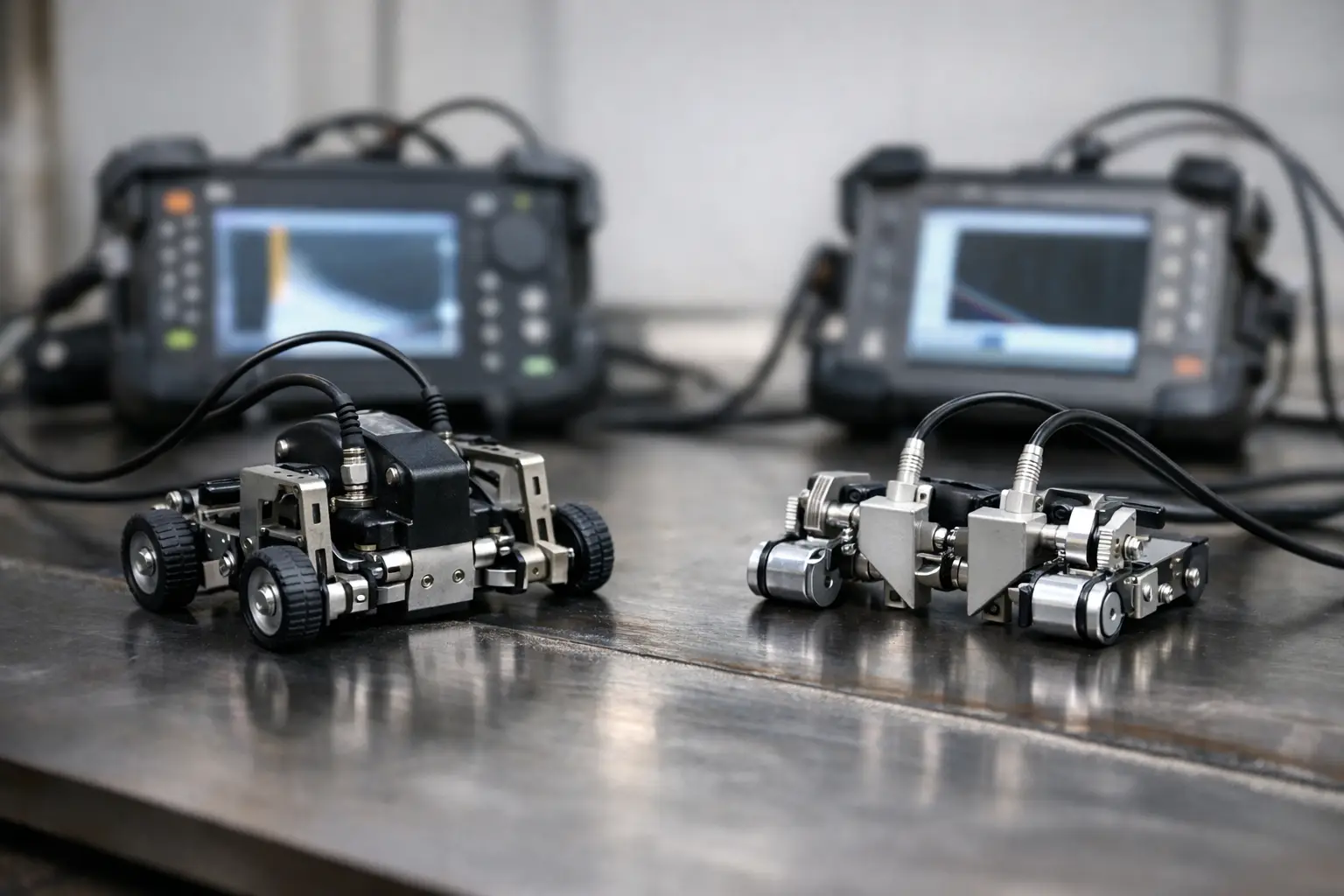

If you have ever tried to force one scanner setup across very different inspection jobs, you already know the real issue behind PAUT vs ToFD scanners is not theory. It is field efficiency. The wrong scanner choice costs time in setup, rebuilds, lost access, extra wear, and sometimes a second trip to site.
For most inspection teams, the question is not which method is better in absolute terms. PAUT and ToFD solve different problems, and the scanner needs to suit the technique, the geometry, and the job conditions. That matters whether you are scanning welds in fabrication, working shutdowns in plant, or trying to keep a small NDT crew productive without tying up one expensive trolley-style system.
PAUT vs ToFD scanners in practical terms
At a method level, PAUT and ToFD are often used together because they complement each other well. PAUT gives you strong imaging flexibility and good positional information across a weld volume. ToFD is valued for fast coverage and reliable diffraction-based sizing of flaws, especially for weld inspection where through-wall extent matters.
But the scanner requirements are not identical.
A PAUT scanner usually needs to support one or more phased array probes, wedges, and encoded movement with stable probe alignment. Depending on the inspection, it may also need room for multiple probe positions, corrosion mapping arrangements, or accessories that let the operator adapt quickly between weld types and surface conditions.
A ToFD scanner is generally built around a transmitter and receiver pair with fixed probe spacing, stable PCS control, and repeatable travel. Probe separation, lift-off control, and alignment are more critical here because small mechanical changes can affect data quality quickly. In other words, ToFD can look mechanically simple, but it is not forgiving of sloppy setup.
That is why scanner selection should start with the job itself, not the catalogue description.
Where PAUT scanners make more sense
PAUT scanners are usually the stronger option when the inspection needs flexibility. If you are dealing with varying weld caps, mixed pipe diameters, nozzle transitions, corrosion areas, or access restrictions, PAUT hardware often gives you more ways to adapt the setup without abandoning encoded scanning.
This matters in real work because inspection conditions are rarely tidy. One day you are on a circumferential weld with enough room to run a standard carriage. The next you are trying to work around clamps, coatings, branch connections, or surfaces that were clearly not prepared with scanner travel in mind.
A good PAUT scanner should let you change probe holders, wedge positions, encoder orientation, and mounting approach without turning the whole job into a bench rebuild. That is especially valuable for contractors and small service companies that need to move between jobs quickly.
PAUT also tends to suit teams that want one method across multiple applications. The same general scanner platform may be adapted for weld examination, basic corrosion mapping, or encoded manual work, provided the mechanical design supports those changes cleanly.
The trade-off is that flexibility can become complexity if the hardware is too generic. A scanner that claims to do everything may spend half its life being reconfigured, and that is where productivity drops. In practice, many operators are better served by having more than one fit-for-purpose scanner rather than one premium system being stripped and rebuilt every second day.
Where ToFD scanners have the edge
ToFD scanners make the most sense when the inspection scope is well defined and repeatability matters more than versatility. Long seam welds, production-style weld inspection, and jobs where rapid encoded coverage is the priority are typical examples.
The strength of a dedicated ToFD scanner is mechanical consistency. Once the probe spacing, wedge arrangement, and travel path are set correctly, the system can deliver efficient scanning with less operator variation. On routine weld inspection, that consistency is a genuine advantage.
ToFD setups can also be lighter and more straightforward than multi-probe PAUT arrangements, particularly when the job only calls for one technique. Less mechanical clutter often means faster deployment and fewer points of failure in the field.
That said, ToFD scanner performance depends heavily on the surface and geometry cooperating. Irregular caps, poor access, variable contact, and difficult transitions can all make the setup harder to trust. If the job includes a lot of changing conditions, a dedicated ToFD arrangement may become less practical than it looks on paper.
The real difference is often mechanical, not ultrasonic
When people compare PAUT vs ToFD scanners, they often focus on the inspection method and ignore the hardware behaviour. On site, the mechanical side usually decides whether the shift goes smoothly.
Probe stability, encoder accuracy, wheel or magnetic traction, frame width, clearance around the weld, cable management, and how quickly the operator can swap configurations all matter. A technically correct scanner that is awkward to mount or too fiddly to adjust can slow a crew down just as much as a poor inspection plan.
This is where purpose-built hardware earns its keep. If the scanner is designed for a specific task, operators spend less time improvising brackets, spacing blocks, and probe holder workarounds. The gain is not just convenience. It is repeatability, less wear on the kit, and less chance of introducing setup error under pressure.
Choosing between PAUT and ToFD scanner setups
The best choice comes down to four job questions.
First, what geometry are you scanning? Flat plate, small-bore pipe, large circumferential welds, and corrosion surfaces all place different demands on the scanner frame and mounting method.
Second, how often does the setup change? If the crew is moving between different weld types or applications in the same week, modular PAUT-capable hardware may save a lot of workshop time. If the work is repetitive and standardised, a dedicated ToFD scanner may be more efficient.
Third, how much access do you really have? Tight clearances often rule out bulkier scanner arrangements, even if they are technically versatile.
Fourth, are you trying to maximise one inspection technique or support a broader service offering? Owner-operators and smaller NDT businesses often need equipment that can cover more job types without constant reinvestment. In that situation, scanner modularity matters nearly as much as scan quality.
Why many teams end up needing both
For a lot of contractors, the answer to PAUT vs ToFD scanners is not either-or. It is both, but in the right form.
PAUT and ToFD are frequently complementary on weld inspection, and the most efficient setup is often one that lets the team deploy each method with hardware matched to the task. That does not mean buying the biggest or most expensive scanner system available. It means avoiding the trap of relying on one overloaded platform for every application.
There is a practical cost to that approach. A single high-end scanner that must be reworked for every new job creates bottlenecks. One technician has the hardware while another waits. Parts wear faster because they are constantly being changed. Small mistakes creep in because the kit is always mid-conversion.
A more sensible model is to use task-specific scanners where the workload justifies it. That may mean one scanner kept ready for a common PAUT weld setup and another set aside for ToFD work. For many businesses, that is a more affordable and scalable way to increase throughput than chasing an all-in-one system.
That thinking sits behind the shift towards modular, application-focused scanner hardware. Practical gear does not need to look premium to solve a field problem well. It needs to be easy to deploy, easy to maintain, and suited to the inspection reality.
PAUT vs ToFD scanners for growing inspection businesses
If you are building capacity, scanner selection should support how your team actually works. A business doing varied shutdown and site work will usually benefit from adaptable PAUT setups and dedicated options for repeat ToFD tasks. A fabrication shop with consistent procedures may lean harder towards fixed-purpose scanners that reduce setup variation.
The point is to buy capacity, not just equipment. That means thinking about technician time, rebuild time, transport, spare parts, and how many jobs can run at once. Scanner hardware should remove friction from the workflow, not become another piece of workshop management.
That is why engineer-led suppliers such as PAUT.Tech have focused on practical alternatives to the traditional scanner model. The goal is not to sell luxury hardware. It is to give inspection teams more usable scanner options, so they can keep jobs moving without overloading one system.
If you are weighing up PAUT vs ToFD scanners, start with the work you do most often, the constraints that slow you down now, and the setups your technicians can trust when the conditions are less than ideal. The right scanner is the one that keeps producing reliable data after the theory has given way to the realities of site access, time pressure, and another weld waiting down the line.