
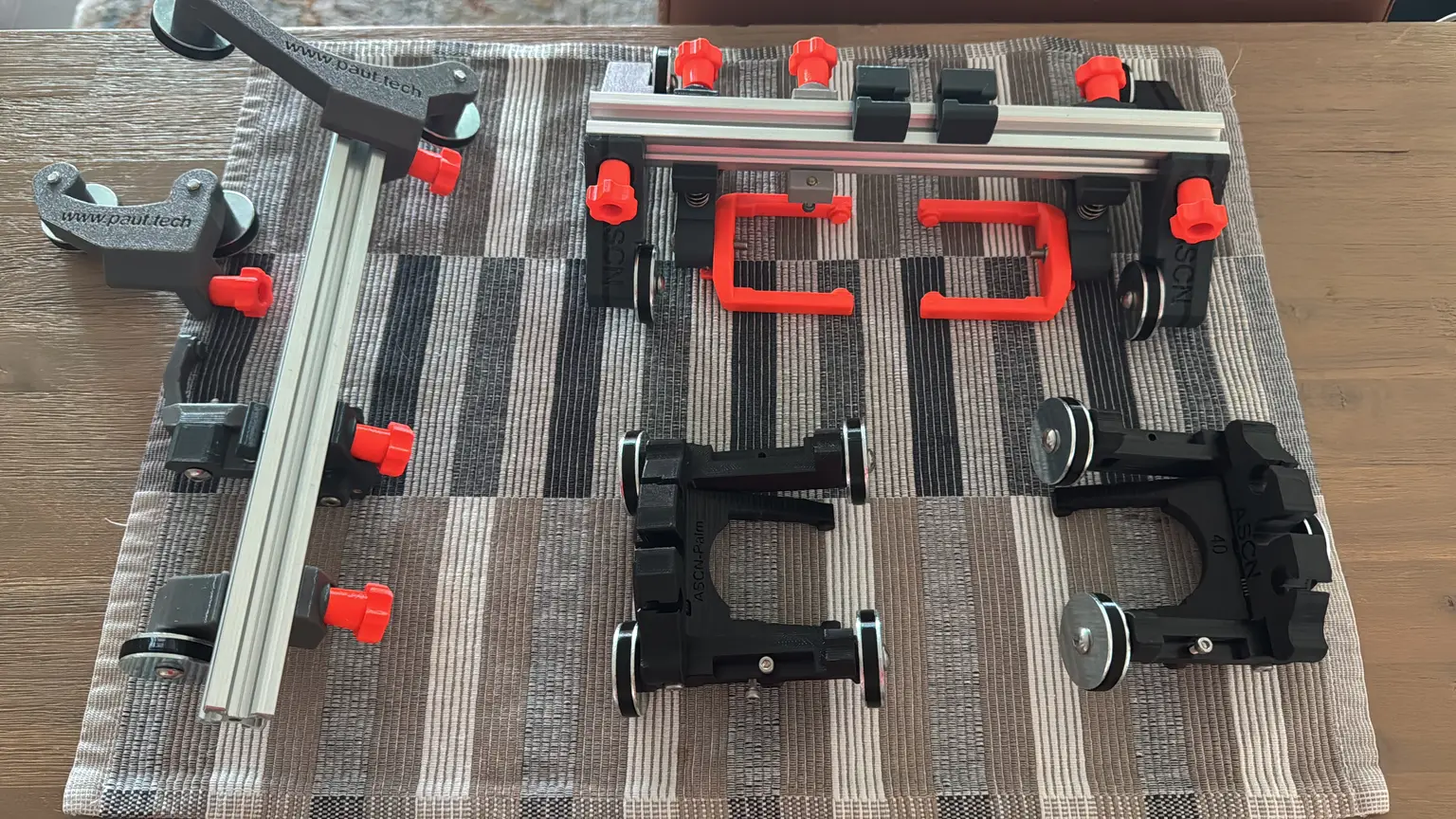

A corrosion mapping crew is booked for the morning. A weld inspection is waiting in the afternoon. If both jobs rely on the same scanner platform, someone is often at the bench changing frames, wheels, probe holders and encoder arrangements between shifts. The future of modular NDT hardware is not about making one scanner do everything. It is about reducing that bottleneck by giving inspection teams practical hardware that is ready for the work in front of them.
For PAUT and ToFD contractors, scanner availability has become as important as instrument availability. A capable ultrasonic unit does not help much when the appropriate mechanical setup is still being rebuilt, adjusted or repaired. Modular hardware changes the conversation from, "How can we adapt our only scanner?" to, "Which purpose-built setup should go to this job?"
Why conventional scanner ownership creates friction
Traditional scanner systems are often purchased as a major capital item, then expected to cover every inspection requirement. That can make sense for a large operation with a dedicated equipment coordinator and a steady flow of similar work. For an owner-operator or a growing NDT business, it can create unnecessary pressure.
One scanner may be configured for encoded weld scanning on Monday, removed from service to suit a small-bore pipe job on Wednesday, and then required for corrosion mapping before the end of the week. Each rebuild introduces delay. It also creates opportunities for incorrect probe spacing, poor wheel alignment, insufficient clamping or a missed encoder check. None of these are complicated problems, but they consume time when crews are already mobilised and access windows are short.
There is also the wear issue. A single premium scanner that travels to every shutdown, workshop and field location becomes the highest-use item in the kit. Components wear at different rates, and a damaged bracket or wheel can sideline the entire assembly. The cost is not limited to a replacement part. It is the lost ability to complete an inspection when the job is live.
The future of modular NDT hardware is purpose-built availability
The most useful modular systems will not be judged by how many configurations they can theoretically achieve. They will be judged by how quickly they can be deployed, how repeatably they scan and whether they suit actual inspection geometry.
That points towards smaller, dedicated scanner assemblies built around common interfaces. A linear weld scanner, a pipe scanner and a corrosion mapping frame do not need to share every mechanical part to share value. They can use compatible encoders, probe holders, mounting methods and cables while remaining set up for their own task.
This approach lets a business keep multiple scanning options in service without purchasing several complete high-cost systems. The result is not duplication for its own sake. It is operational capacity. One technician can prepare a PAUT weld scan while another takes a separate corrosion setup to site, without either crew waiting for hardware to be stripped down.
Dedicated setups reduce variation at the job
A scanner that remains configured for a recurring application is easier to check before mobilisation. The probe positions are known, the encoder direction is familiar, and the operator can confirm the setup against a proven procedure rather than rebuilding from memory.
That matters most where repeatability affects reporting confidence. For encoded PAUT, consistent probe travel and stable indexing support cleaner data collection. For ToFD, maintaining the correct probe centre separation and travel alignment is fundamental. Modular hardware should make those controls easier to hold, not leave them to last-minute adjustment on a vessel, pipe rack or fabrication floor.
There will still be jobs that require adjustment. Pipe diameters vary, weld caps are not always consistent, and access can be poor. The point is to confine adjustment to the parts that genuinely need it, rather than reconfiguring an entire scanner platform for every change in scope.
Common interfaces matter more than universal frames
A modular fleet works when the connections between components are deliberate. Probe holders need sufficient adjustment for wedge and probe combinations, but they also need positive location once set. Encoder mounts must preserve alignment. Cable routing must avoid snagging while allowing technicians to replace a damaged lead without dismantling half the scanner.
Standardising these interfaces makes spares more useful and training more straightforward. A technician who understands one encoder connection or holder arrangement should not need to relearn the system for every frame. At the same time, standardisation should not force unsuitable geometry onto a specialised task.
This is where the idea of a universal scanner can become misleading. A large frame with endless accessories may be flexible, but it can also be heavier, slower to assemble and less comfortable in restricted access. In many cases, a compact scanner designed around one application is the more versatile business decision because it gets used more often.
Additive manufacturing will speed up practical iteration
3D printing has a clear role in the next generation of NDT hardware, particularly for application-specific bodies, brackets, guides and accessories. It allows manufacturers to develop shapes that suit real probe positions, pipe profiles and hand access without the cost and lead time of conventional machining for every variation.
That does not mean every printed component should be treated as interchangeable with a machined metal part. Material selection, wall thickness, fastener design, temperature exposure and expected loading all matter. A scanner used beside hot pipework, exposed to ultraviolet light, or dragged across abrasive steel needs a different design response from one used on a clean workshop bench.
The advantage is practical iteration. When field experience identifies a cable snag point, an awkward locking knob or a holder that needs more clearance, the design can be improved without waiting for a complete platform redesign. This is the engineering logic behind PAUT.Tech: build task-specific hardware around how technicians actually scan, rather than asking technicians to work around an oversized system.
Data quality remains the non-negotiable
Lower-cost and modular hardware should never be confused with lower control of the scan. The mechanical arrangement is part of the inspection system. If a scanner slips, lifts, rocks on the surface or introduces encoder error, the consequences appear in the data.
For PAUT, stable travel helps maintain positional confidence across the weld volume. For corrosion mapping, even contact and controlled scan pitch support meaningful coverage and thickness presentation. For ToFD, probe alignment and consistent separation directly affect the quality of diffracted signal collection.
The future therefore belongs to modular designs that are simple without being loose. Frames need enough stiffness for their intended scan speed and surface. Wheels or guides need appropriate grip without damaging coatings or causing erratic movement. Locking features should be accessible in gloves and resist movement during normal use. These details are not premium extras. They are the difference between a scanner that looks adaptable and one that performs in the field.
Where modularity has limits
Not every inspection should use the lightest or least expensive setup. Long encoded scans, demanding code work, high-temperature surfaces and complex geometry may justify more specialised hardware, additional support or a slower scanning approach. Inspection procedures, client specifications and the capabilities of the operator remain the governing factors.
There is also a limit to how many scanner variants a small business should hold. A fleet of highly specialised tools can create its own storage, maintenance and calibration burden if each unit only sees occasional use. The sensible approach is to identify the jobs that recur often enough to justify dedicated equipment, then keep adaptable accessories for the less common work.
A good starting point is to review the last six to twelve months of jobs. Look for repeated scanner rebuilds, recurring pipe sizes, regular weld profiles and situations where a crew waited for hardware to return from another site. Those patterns reveal where a dedicated setup will remove friction first.
Build capacity around the work you actually win
The next step for NDT hardware is unlikely to be one all-purpose scanner with a larger accessory catalogue. It will be a practical mix of compatible, task-focused equipment that lets inspection businesses send the right setup with the right technician.
Start with the application that causes the most rebuild time or scheduling conflict. Put a stable, repeatable scanner against that job and leave it configured where possible. When the next recurring bottleneck appears, add capacity there rather than buying complexity for every possible future task. That is how modular hardware earns its place in the ute, on site and in the inspection schedule.