
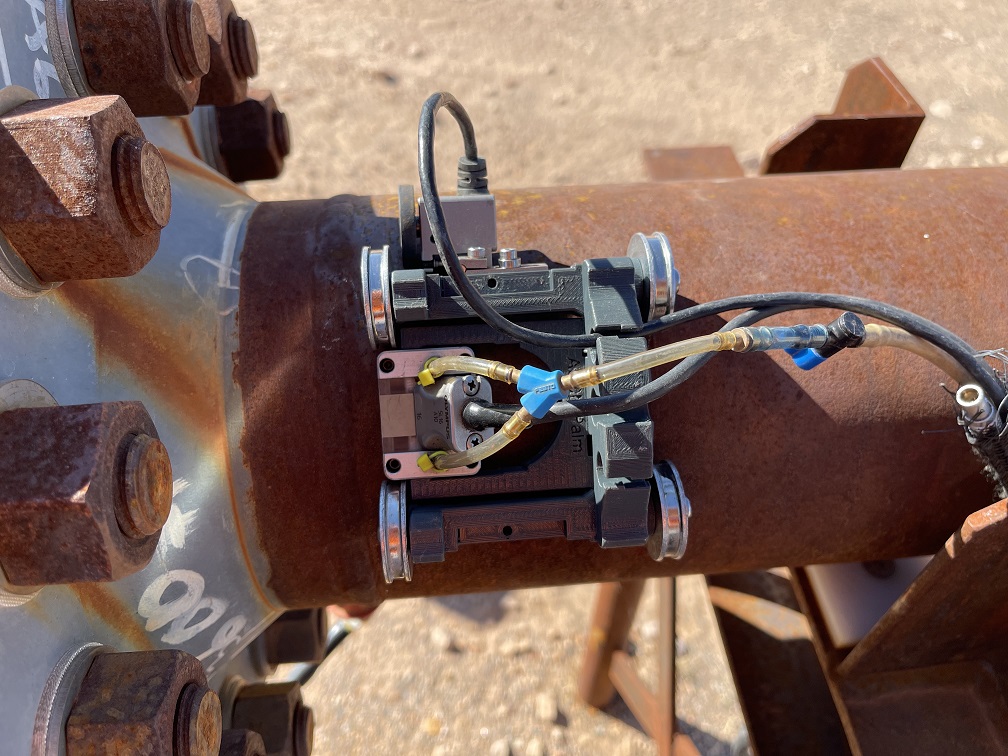

If you are still trying to cover every weld job with one scanner frame and a box of spare parts, you already know where the time goes. A PAUT scanner for weld inspection is not just about probe movement - it is about getting repeatable data on real jobs, with less rebuilding, less compromise and fewer delays between setup and scan.
For most inspection teams, the scanner becomes the difference between a tidy scan plan and a rushed workaround. On paper, almost any manual or encoded setup can look acceptable. In the field, scanner stability, encoder consistency, wedge fit-up and access around the weld are what decide whether the data is usable, repeatable and efficient enough to deliver on time.
Why the scanner matters more than many teams admit
Weld inspection with phased array is rarely limited by the instrument alone. Modern flaw detectors are capable, software is mature, and scan plans can be built with a high degree of control. The weak point is often the mechanical side of the job.
If the scanner drifts, lifts, binds or cannot maintain consistent travel, the data quality suffers. If the encoder slips, your index position is no longer trustworthy. If the frame is oversized for the job, setup takes longer and access becomes a fight. None of that is a software problem. It is a scanner problem.
That matters most on production welds, shutdown work and site inspections where time pressure is real. The best PAUT scanner for weld inspection is not the one with the biggest frame or the highest price tag. It is the one that suits the weld geometry, scanning method and access constraints without forcing the technician into constant adaptation.
What a PAUT scanner for weld inspection actually needs to do
At a basic level, the scanner has to move the probe assembly along the weld path in a controlled and repeatable way. In practice, that means more than rolling from one end to the other.
A good scanner needs stable contact, reliable encoder feedback, practical probe and wedge mounting, and enough adjustment to suit the application without becoming fiddly. It also needs to survive field handling. Weld inspection hardware gets carried, knocked about, packed into cases, set on steelwork and used in conditions that are not clean or predictable.
For butt welds on plate, the priority may be straight tracking and easy placement. For circumferential welds on pipe, the scanner has to maintain alignment around changing positions and often awkward access. For ToFD and PAUT combined setups, mounting geometry and probe spacing become just as important as simple travel.
This is where fit-for-purpose hardware earns its keep. A modular system can be valuable, but only to the point that it still feels practical on the job. Too much configurability can become its own burden if every inspection starts with a rebuild on the tailgate.
The trade-off between one universal scanner and task-specific setups
A lot of inspection businesses start by trying to make one scanner do everything. It makes sense from a purchasing point of view, especially when capital spend is under pressure. The problem shows up later in utilisation.
One scanner that can theoretically handle plate welds, small-bore pipe, larger circumferential welds and corrosion mapping often needs regular reconfiguration. That means downtime, more wear on parts, and more opportunities for setup error. It also means one team can become a bottleneck if the hardware is tied up on another job.
Task-specific scanners change that equation. Instead of overworking one premium frame, you can keep dedicated hardware ready for recurring applications. For owner-operators and small to mid-sized NDT companies, that can be the difference between adding capacity and constantly juggling equipment.
There is still a balance to strike. If your work mix is highly varied and low volume, one adaptable setup may be sensible. But if you are repeatedly inspecting similar weld types, dedicated or semi-dedicated scanners usually improve turnaround and reduce handling time.
Choosing a PAUT scanner for weld inspection
The right scanner starts with the weld, not the catalogue. Plate welds, nozzle welds, small-diameter pipe and heavy-wall circumferential welds all place different demands on the mechanics.
Start with weld geometry and access
A scanner that works well on open plate can be frustrating on a congested pipe rack. Clearance around clamps, supports, insulation breaks and nearby components matters. So does the surface condition. Painted, scaled or uneven surfaces can affect wheel contact and stability.
For pipe work, diameter range is one of the first checks. A scanner may be adjustable on paper, but the real question is how quickly and reliably it can be set for the diameters you inspect most often. If the adjustment process is slow, your crew pays for it on every setup.
Match the scanner to the inspection method
Not every weld scan is a simple one-probe pass. Some jobs call for PAUT only. Others need PAUT and ToFD in the same deployment. Some require encoded scans with strict positional confidence, while others are more about efficient field screening.
The scanner should support the probe arrangement you actually use, including wedge type, spacing and cable management. A scanner that technically accepts multiple accessories but becomes awkward once fully rigged is not helping productivity.
Pay attention to encoder reliability
Encoder performance is easy to overlook until data review starts. If you cannot trust position, you cannot fully trust the scan. Wheel design, mounting rigidity and contact consistency all affect encoder quality.
This is one area where simple, well-resolved mechanics usually beat overcomplication. A dependable encoder setup that survives routine handling is worth more than an elaborate design that needs constant checking.
Think about rebuild time
Field efficiency is not just scan speed. It includes how long it takes to unpack, adjust, mount probes, confirm alignment and begin collecting data. A scanner that saves ten minutes on each setup can make a noticeable difference across a shutdown or fabrication campaign.
That is why practical inspectors tend to favour hardware that is easy to understand at a glance. Fewer unnecessary parts, straightforward adjustments and repeatable mounting positions reduce setup friction.
What good scanner design looks like in the field
In day-to-day weld inspection, the best hardware often looks almost uneventful. It goes on quickly, tracks properly and does not need constant attention. That is the standard worth aiming for.
Good design is usually visible in a few areas. The frame is stiff enough to keep geometry consistent. Probe holders adjust without feeling loose. Wheels or magnetic contact points suit the surface and path. The scanner is light enough to handle easily, but not so light that it feels flimsy.
Material choice matters too, especially for businesses trying to control costs without sacrificing usefulness. Not every scanner needs to be a heavy, premium-priced assembly. Well-designed 3D-printed components, used where they make mechanical sense, can reduce cost and keep the system practical without pretending to be something it is not. That approach works when the design comes from actual inspection use rather than from trying to impress in a showroom.
Where teams lose time on weld scans
Most inefficiency in PAUT weld work comes from repeatable causes. The scanner is too general-purpose for the task. The setup takes too long. The hardware is tied up on another job. The frame needs rebuilding for a different probe arrangement. Or the scan starts with compromises because the scanner is not well matched to the weld.
Those issues are rarely dramatic, but they add up. A few extra minutes on each weld, a second trip to fetch another bracket, a questionable encoder trace that needs to be checked again - this is how margins disappear.
That is why many inspection businesses are moving away from the idea that one expensive scanner should cover every scenario. Practical fleets are often more useful than prestige hardware. If you can put the right scanner on the right job quickly, you improve utilisation and reduce equipment strain at the same time.
PAUT.Tech is built around that reality. The aim is not to replace every premium scanner in the market with a single do-it-all frame. It is to give inspection teams practical, affordable hardware that suits the work and lets them scale capability without carrying unnecessary cost.
When a cheaper scanner is the better choice
Cheaper does not always mean better value, and premium does not always mean better performance. The better choice depends on duty cycle, application range and how your team actually works.
If a scanner is going to be heavily specialised, used often, and exposed to the usual abuse of field inspection, affordability can be a strength. It allows businesses to keep multiple setups available instead of treating scanner hardware as a single precious asset. That reduces downtime and lowers the pressure to make one frame do jobs it was never really suited to.
The key is honesty about the application. If you need a scanner for a very narrow, high-precision or unusual geometry requirement, you may need a more specialised build. But for a large share of routine weld inspection work, practical and well-matched hardware often delivers the better result.
The useful question is not whether a scanner looks impressive on the bench. It is whether it helps your crew get clean, repeatable weld data without wasting half the shift on setup and adaptation. Choose on that basis, and the scanner starts working like a tool instead of a project.
The best hardware usually proves itself quietly - by being ready when the weld is ready.