
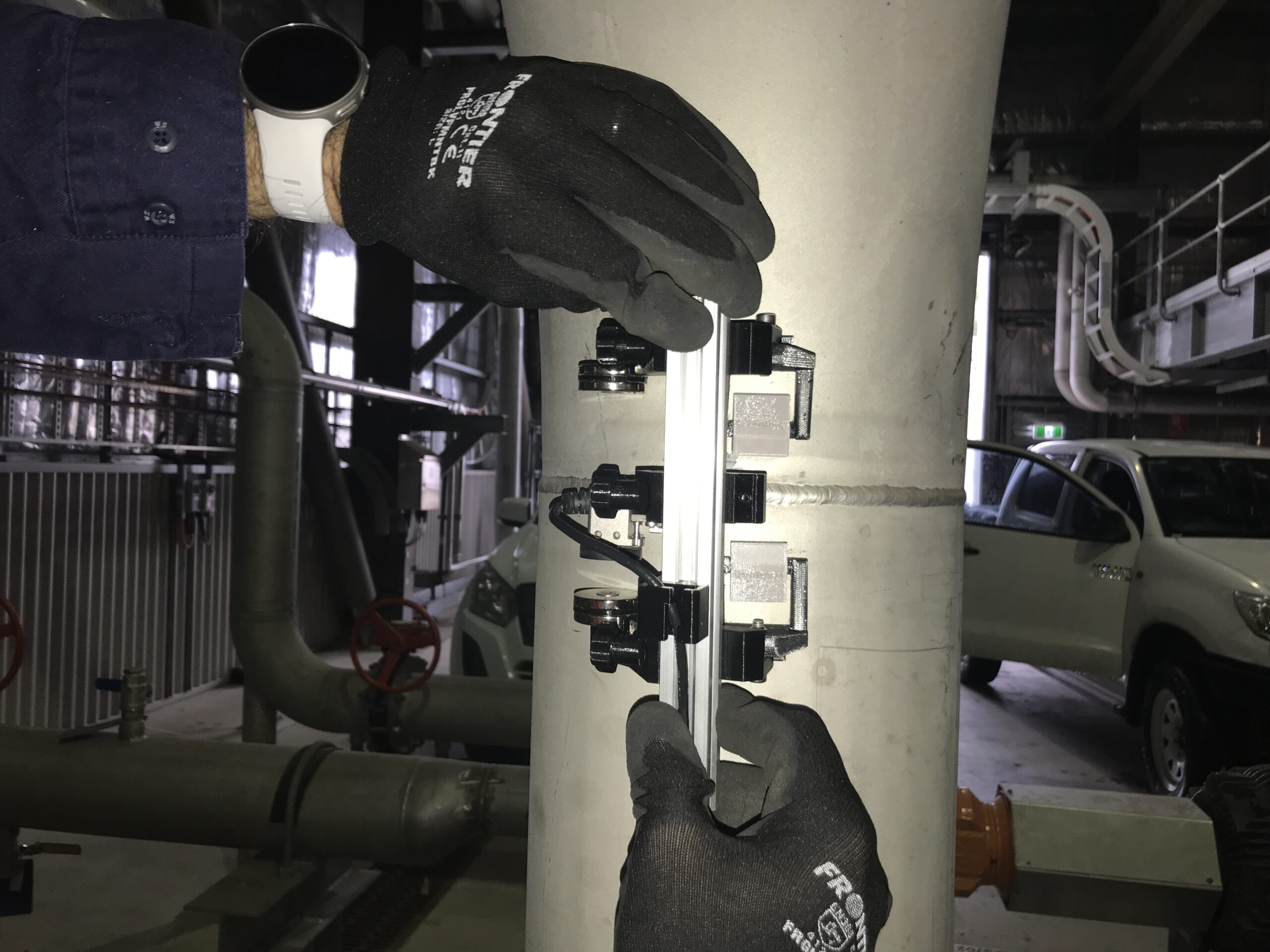

A TOFD scanner for pipeline welds earns its keep long before the first A-scan appears on screen. If the scanner slips on coating, chatters over cap profile, or takes too long to set up between welds, the whole inspection slows down. On pipeline work, that is usually the real problem - not whether TOFD works, but whether the hardware can apply it consistently in field conditions.
Pipeline weld inspection is rarely a controlled workshop exercise. You are dealing with varying diameters, different cap conditions, restricted access, weather, and the pressure to keep production moving. In that setting, scanner choice matters because it affects data quality, crew efficiency, and how much equipment handling is required from one weld to the next.
What a TOFD scanner for pipeline welds actually needs to do
At a basic level, the scanner has to carry the probes at a fixed separation, maintain stable contact around the circumference, and deliver reliable encoder feedback. That sounds straightforward until you put it on a real pipe. Even a small issue in wheel grip, frame alignment, or encoder mounting can show up as poor positional accuracy or inconsistent coupling.
For pipeline welds, repeatability matters more than fancy hardware features. The scanner needs to track cleanly around the weld without rocking, and it needs enough adjustability to suit the probe pair, wedge combination, and pipe diameter being inspected. If you are switching between jobs, simplicity also matters. A scanner that takes constant rebuilding can become a bottleneck, especially for small inspection teams trying to cover multiple scopes with limited kit.
That is why purpose-built hardware often makes more sense than relying on one premium scanner for everything. In practice, many crews are not chasing a single universal frame. They are trying to reduce setup time, avoid unnecessary wear, and keep a scanner ready for the next weld rather than stripping one apart after every task.
Stability and encoder performance come first
If the scanner cannot move smoothly, the rest of the setup is compromised. Pipeline weld TOFD depends on accurate positional information. Encoder errors distort interpretation, and poor mechanical tracking can make good probe setup look bad.
Why wheel contact and frame balance matter
On circumferential welds, the scanner needs even pressure and predictable travel. Too much frame flex or poor wheel placement can cause lift-off through parts of the scan. That creates inconsistent coupling and can make the data harder to trust, particularly when you are looking for small diffraction responses.
A well-designed scanner keeps the probes stable without becoming overbuilt. More mass is not always better. Heavy frames can be awkward on vertical or awkwardly positioned pipe, and they can be slower to deploy. The better approach is a scanner with enough rigidity for repeatable tracking, but not so much complexity that routine setup becomes a job in itself.
Encoder mounting is not a minor detail
It is easy to focus on the probe holders and forget the encoder, but on TOFD work the encoder is part of the inspection result. A scanner with a reliable, well-protected encoder arrangement will save rework later. If the encoder wheel loses contact, gets knocked out of line, or sits in a vulnerable position during handling, scan integrity suffers.
Field crews usually value encoder setups that are easy to check, easy to replace if damaged, and not buried inside a frame that requires half the scanner to be dismantled for basic maintenance.
Pipe diameter, weld profile and access change the answer
There is no single best TOFD scanner for pipeline welds in the abstract. The right choice depends on what the pipe actually looks like and how often the setup needs to change.
Small diameter pipe can expose any weakness in scanner geometry. Tight curvature affects wheel spacing, frame clearance and probe alignment. A scanner that performs well on larger process pipe may be less comfortable on smaller lines, especially if the weld cap is high or access is restricted by supports, adjacent spools or insulation breaks.
Larger diameter pipe gives you more room, but it also highlights efficiency issues. On repetitive weld programs, small setup delays add up quickly. If the scanner is awkward to mount, or if changing probe spacing is a slow process, crews lose time on every weld.
Weld condition matters as well. Fresh fabrication, coated service pipe and rough field welds all place different demands on the scanner. Good wheel grip and sensible clearance are worth more than unnecessary adjustment points. In the field, every extra fastener or alignment step is another chance to waste time or introduce error.
Modularity is useful, but only when it stays practical
A modular scanner can be a smart choice for inspection businesses handling different pipe sizes and procedures. The advantage is obvious - one base platform can support different probe holders, wheel options or frame configurations. But modularity only helps when the changes are quick and repeatable.
Some systems promise flexibility but rely on too many add-on parts and too much bench time. That can work in a training room. It is less appealing when technicians are working outdoors, changing setups between jobs, and trying not to misplace hardware in the back of the ute.
The better modular designs are task-focused. They give enough adjustment to cover the intended work without turning each reconfiguration into a rebuild. For many inspection businesses, that is the point where scanner hardware starts paying for itself. Instead of forcing one scanner into every role, you can keep dedicated or semi-dedicated setups ready for common jobs.
That approach suits how many NDT teams actually operate. It reduces downtime, spreads equipment wear, and makes it easier to scale capacity without committing to a single expensive platform.
What technicians usually regret after purchase
Most scanner complaints are not about TOFD performance in theory. They are about ownership in practice. A scanner may look capable on paper, then become frustrating because it is too fiddly, too slow to adapt, or too fragile for regular site use.
One common mistake is buying around specifications alone. Probe range, diameter range and accessory count all sound good in a product sheet, but they do not tell you how long the scanner takes to set up on a live job. Another is assuming a more expensive scanner will automatically improve inspection outcomes. Sometimes it does. Often it just means you own a more costly piece of hardware that still needs careful handling and still has to fit the job.
There is also the issue of overcommitting to a single scanner platform. If that scanner is constantly being reconfigured for different welds, corrosion work or phased array scans, it becomes a choke point. The team spends time rebuilding hardware instead of scanning. For owner-operators and smaller service companies, that is where practical, job-specific equipment can make a bigger difference than premium branding.
How to assess a scanner before it goes to site
A good evaluation is less about brochure features and more about workflow. Ask how quickly the frame can be mounted, whether probe separation can be adjusted without fuss, and how easy it is to keep the encoder running accurately. Think about transport as well. If the scanner is awkward to pack, delicate in transit, or loaded with loose parts, it will not stay efficient for long.
It is worth checking how the scanner handles routine abuse. Not misuse, just normal field handling - in and out of cases, onto pipe stands, around coated surfaces, and through repeated setup cycles. Practical hardware should tolerate that without needing constant attention.
For many pipeline jobs, the right answer is not the most elaborate scanner. It is the one that gives stable scans, fast deployment and enough adaptability to cover the procedure without getting in the way. That is the logic behind fit-for-purpose designs, and it is why businesses like PAUT.Tech focus on scanner hardware that solves actual inspection constraints rather than trying to be everything at once.
Choosing for the job, not the catalogue
If your work is mostly repetitive pipeline weld inspection, choose a TOFD scanner around repeatability and speed. If your jobs vary widely, put more weight on modularity, but be honest about how much reconfiguration your crew can tolerate before efficiency starts dropping. And if your current setup is being rebuilt for every second job, that is usually a sign the scanner is doing too much, not that the team needs to work harder.
Good pipeline TOFD hardware should feel predictable. It should mount cleanly, track properly, and let the technician focus on the scan rather than fighting the frame. That is generally the difference between equipment that looks capable and equipment that actually earns a spot in the kit.