
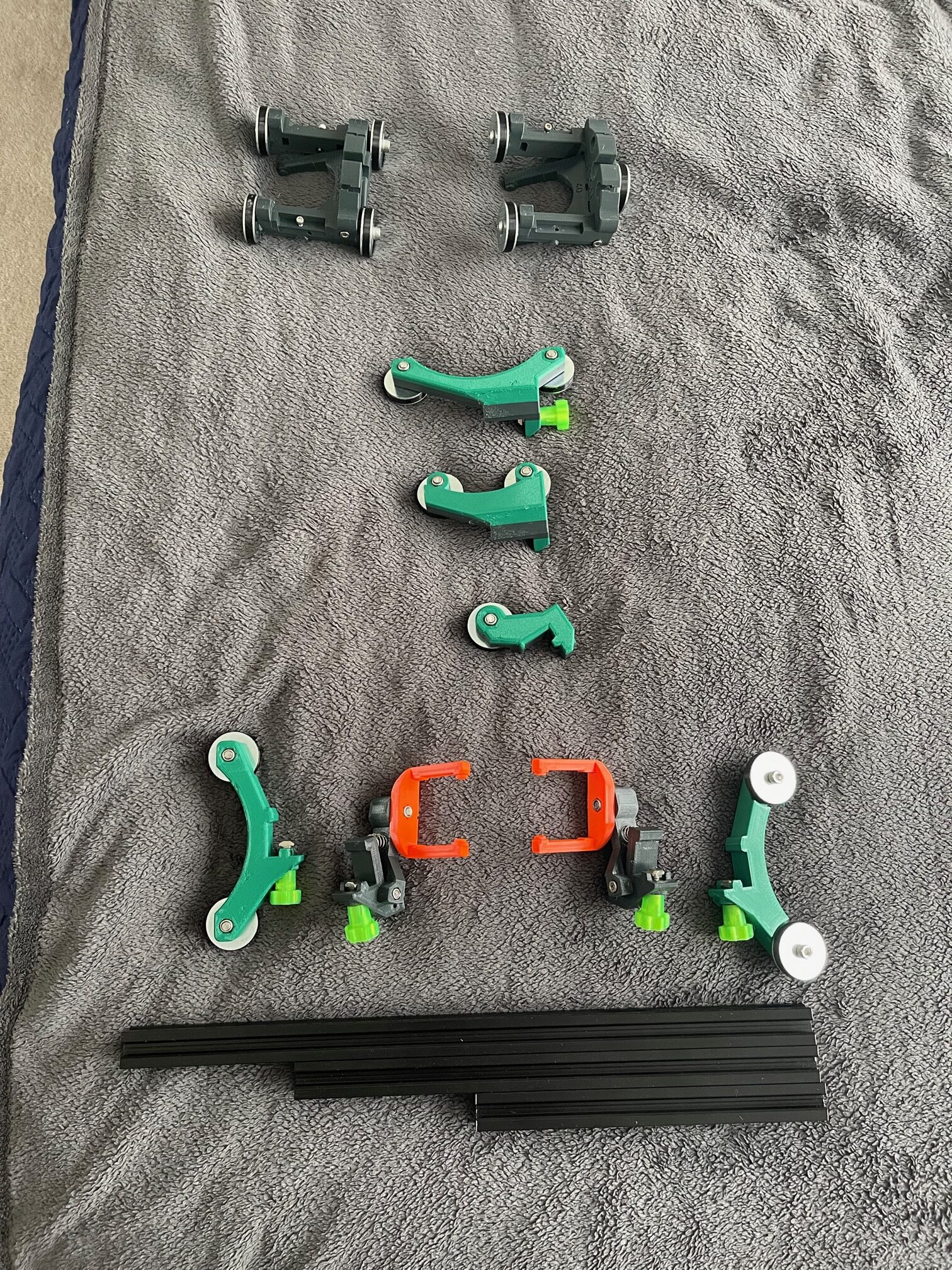

Anyone who has spent a week bouncing between a butt weld, a small-bore pipe and a corrosion map knows the problem straight away - one scanner rarely stays ideal for long. The more varied the work, the more a modular NDT scanner system starts to make sense. Not as a fancy extra, but as a practical way to keep crews moving, reduce rebuild time and stop one piece of hardware becoming the bottleneck for every job.
For a lot of inspection businesses, the issue is not whether a scanner can technically be reconfigured. It is how often that reconfiguration chews up time, introduces setup inconsistency and puts extra wear on components that are constantly being stripped down and rebuilt. On paper, one premium scanner platform can look efficient. In the field, it often means technicians are burning time in the crib room or the back of the ute swapping brackets, changing wheel spacing, adjusting probe holders and trying to get encoder alignment right before they can even start scanning.
What a modular NDT scanner system actually solves
At its best, a modular NDT scanner system is not just a kit with interchangeable parts. It is a way of matching scanner hardware to the inspection task without forcing one tool to carry every application. That matters in PAUT and ToFD because scan quality depends on repeatability, stability and geometry. If the scanner does not suit the surface, weld profile or access conditions, the data suffers before the instrument has had a chance to do its job.
A modular approach lets you build around common elements such as encoders, probe holders, wedges and mounting options, while still using task-specific frames or carriers where needed. That means a technician can move between plate welds, circumferential pipe scans and corrosion work without treating every job as a full rebuild exercise.
The operational gain is usually bigger than the catalogue description suggests. You are not only buying flexibility. You are reducing downtime between jobs, lowering the chance of setup errors and giving your team a better shot at repeatable results across different applications.
Why one scanner for everything usually falls short
There is always a trade-off with all-in-one hardware. A scanner designed to cover every scenario tends to become heavier, more complex or slower to adapt. It may still perform well, but the cost is usually paid in setup time and field practicality.
For example, a scanner that works nicely on larger diameter pipe may be awkward on tight access welds. A frame suited to corrosion mapping may not be the quickest option for straightforward linear weld scanning. Even if the hardware can be adapted, the question is whether that adaptation is worth the effort every single day.
This is where smaller inspection businesses feel the pain first. If you have only one or two scanner platforms in circulation, every job change affects scheduling. One crew is waiting for hardware to come back. Another is rebuilding it for a different application. The scanner becomes shared infrastructure rather than a ready-to-go tool.
That problem gets worse as service offerings expand. The moment a business takes on more mixed work - fabrication, shutdown support, piping, tank floor spot work, general corrosion assessment - scanner availability starts affecting revenue just as much as technician availability.
Modular scanner systems and real job fit
A good modular setup is less about endless configurations and more about sensible ones. In practice, most inspection teams do not need infinite adjustment. They need a few proven hardware arrangements that cover common work reliably.
That might mean one scanner set up for encoded weld scanning, another dedicated to pipe applications, and a third arranged for corrosion or mapping tasks. Shared accessories and compatible components still matter because they keep inventory simple. But the real advantage is that each scanner stays closer to job-ready.
That is a very different proposition from constantly pulling one unit apart. It reduces mechanical fatigue on the hardware and mental fatigue on the operator. When a technician grabs a scanner, they should not have to rethink the entire layout from scratch.
This is one reason modular hardware has become more attractive to owner-operators and smaller NDT firms. Instead of stretching budget into one expensive platform and hoping it can cover everything efficiently, they can build capability across multiple fit-for-purpose units.
Where modularity matters most in PAUT and ToFD
Weld scanning
For weld inspection, stability and consistent probe positioning matter more than brochure flexibility. A modular scanner system helps when weld caps vary, surfaces are not ideal, or access around the weld is restricted. Being able to change holders, wheel arrangements or carriage geometry without replacing the whole scanning concept is useful. But there is a limit - too much adjustment can slow the crew down.
That is why practical modularity matters more than theoretical modularity. The best setups allow technicians to make the adjustments that actually come up on site, not spend half the shift fiddling with features they never use.
Pipe work
Pipe scanning exposes the value of dedicated geometry quickly. Diameter changes, clamp requirements and circumferential travel all place different demands on the scanner. A modular system is useful here because it can support different pipe ranges and probe arrangements while keeping components familiar. Still, there is no getting around the fact that some pipe jobs are easier with a purpose-built pipe scanner than with a heavily adapted general frame.
Corrosion and mapping
Corrosion work often calls for coverage, repeatability and efficient movement over broad areas. The scanner does not need to do the same job as a weld carriage. Modular systems work well when they let teams swap into a mapping-friendly setup without rebuilding every component from zero. If the changeover is clumsy, the benefit disappears.
The cost argument is not just purchase price
A lot of scanner discussions get stuck on upfront capital cost. That matters, obviously, but it is only part of the equation. The bigger cost on many jobs is idle labour, delayed deployment and reduced utilisation of technicians and instruments.
If two qualified operators are standing around while one scanner is being reconfigured, the business is already paying more than it should. If a rushed rebuild leads to poor coupling, encoder issues or inconsistent probe alignment, the rework cost is higher again.
This is where a modular NDT scanner system earns its place. Not because it is the cheapest item on a quote, but because it can reduce the hidden costs that stack up around scanner availability and setup time.
For many teams, affordability is not about buying the least expensive tool. It is about getting more useful hardware into the field without tying up the budget in one premium platform. That is a different way of thinking about value, and in many cases it is a more realistic one.
Choosing the right modular NDT scanner system
The right choice depends on the work mix. A contractor doing mainly coded weld inspection on similar components has different needs from a service company jumping between shutdown piping, structural welds and corrosion screening.
Start with the jobs that generate the most scanner handling time, not just the jobs that look most technically demanding. If your team is constantly rebuilding for common tasks, that is where modularity will pay off first. Look at how often you change probe holders, swap encoders, alter wheel positions or move between pipe and flat work. Those repeated changes are where inefficiency lives.
It also helps to think about who is using the equipment. A system that depends on fine adjustment every time may suit an experienced specialist, but not a busy crew trying to get multiple jobs out the door. Simplicity counts. Field hardware should be easy to understand, easy to maintain and hard to set up badly.
That is the appeal of practical, engineer-led scanner design. Businesses such as PAUT.Tech are focused on giving inspection teams hardware that fits real applications without forcing them into overbuilt, high-cost platforms that spend too much of their life being reconfigured.
Modularity works best when it stays practical
There is no perfect scanner architecture for every NDT business. Some teams genuinely need highly configurable systems. Others are better served by several simpler scanners with shared accessories. It depends on job variety, crew size and how often hardware gets redeployed across applications.
What does not change is the field reality. Inspection work rewards gear that is ready, repeatable and suited to the task in front of you. If a modular NDT scanner system helps you get there faster, with less rebuild time and less compromise, it is doing exactly what scanner hardware should do - staying out of the way so the inspection can get done properly.
The useful question is not whether modularity sounds good on paper. It is whether your current setup is costing you time every week, and whether a better hardware approach would let your team spend more of the day scanning and less of it rebuilding.