
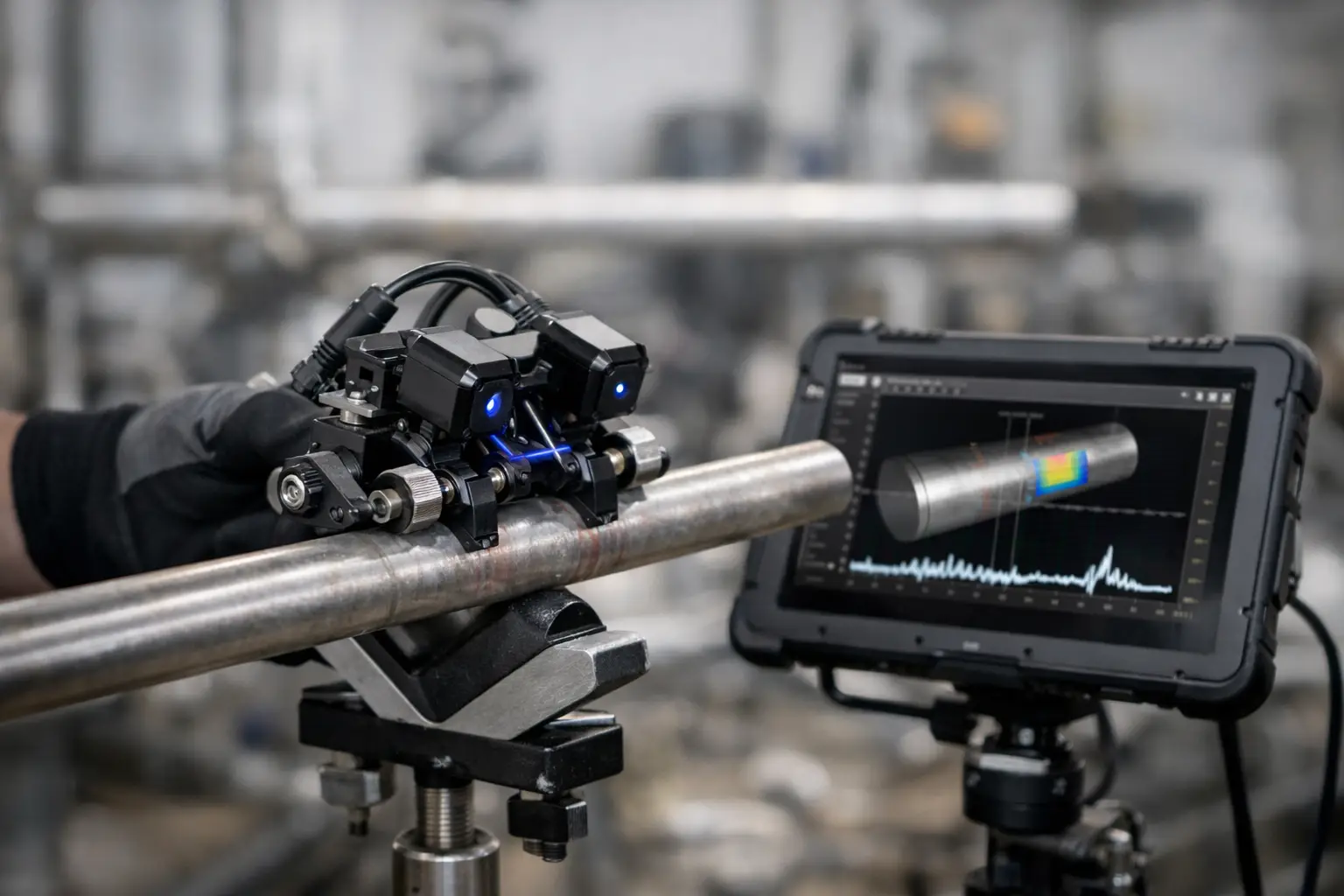

Anyone who has tried to scan a 2 inch or 3 inch line with hardware designed around larger pipe already knows where the trouble starts. A scanner for small diameter pipe has to do more than simply clamp on. It needs to track consistently, keep the probe position stable, and give the technician enough access to do the job without turning a straightforward inspection into a workshop exercise.
That is the real issue with small diameter work. The geometry is less forgiving, the surface area is limited, and the scanner footprint that feels stable on larger pipe can become awkward very quickly. If the frame is too wide, the wheel spacing is wrong, or the probe holders do not give enough adjustment, the hardware starts fighting the inspection.
What makes a scanner for small diameter pipe different
Small diameter pipe changes the mechanical problem before it changes the ultrasonic one. On larger pipe, you can usually get away with more scanner mass, more wheel spread, and a bit more tolerance in how the frame sits. On smaller diameters, every millimetre matters. The curvature is tighter, the contact patch is reduced, and any inconsistency in wheel loading or bracket alignment is more likely to show up in the scan.
That affects more than just comfort. It influences encoder reliability, wedge presentation, couplant behaviour, and repeatability from pass to pass. If the scanner rocks, drags, or needs constant repositioning, data quality suffers and inspection time blows out.
A practical scanner for small diameter pipe should be built around fit-for-purpose geometry. That usually means a compact frame, controlled probe positioning, and enough modular adjustment to suit different pipe sizes without forcing a full rebuild every time the job changes.
The main selection points that actually matter
When technicians compare scanner options, there is often too much focus on whether the unit looks heavy-duty and not enough on whether it suits the task. For small diameter pipe, the better question is whether the hardware stays stable and usable in the field.
Frame size and pipe conformity
The scanner frame needs to sit naturally on the pipe without excessive offset or awkward wheel angles. A frame that has been scaled down properly will usually perform better than a general-purpose scanner pushed into a diameter range it was not really meant for.
This is where compact design earns its keep. A smaller frame can improve access around weld caps, clamps, nearby supports, and congested plant layouts. It also tends to be easier to deploy when you are working in less-than-ideal positions, which is common enough on live sites and shutdown work.
Encoder performance
If the encoder skips, slips, or chatters, the rest of the scan setup does not matter much. Small diameter pipe can make encoder tracking more sensitive because the scanner has less room to settle and less tolerance for poor wheel contact.
A good setup keeps wheel pressure consistent and avoids geometry that encourages lift or side-loading during travel. This is particularly important where surface condition is average rather than perfect, which in field inspection is most of the time.
Probe and wedge positioning
Probe access becomes tighter as the diameter drops. You need enough adjustment to place the probes where they need to be, while still keeping the wedges properly seated and the scanner balanced. If the holders are too bulky or the adjustment range is limited, the setup starts becoming a compromise.
For PAUT and ToFD work, that compromise can show up in coverage, beam targeting, and repeatability. The scanner should make it easier to position probes correctly, not force you into a near enough arrangement because the mechanics run out of travel.
Why modularity matters more on small pipe jobs
A lot of inspection businesses still rely on one expensive scanner platform that gets rebuilt for every second job. On paper that sounds efficient. In practice it often means technicians spend too much time reconfiguring hardware, chasing missing parts, and putting wear into the same frame over and over.
Small diameter work exposes this problem quickly. These jobs often need a specific mechanical arrangement, and they are less tolerant of makeshift adaptation. If your team is constantly converting one scanner from corrosion mapping to circumferential weld scanning to tight-radius pipe work, downtime creeps in and deployment becomes harder to control.
That is why modular, task-specific hardware makes sense. Instead of asking one scanner to cover every possible application, it is often more practical to have equipment configured for the jobs you actually do. For owner-operators and smaller NDT companies, that can be the difference between a scanner that earns its keep and one that spends too much time on the bench.
Common mistakes when choosing a scanner for small diameter pipe
One of the most common mistakes is buying on broad capability instead of real working range. A scanner may technically fit smaller pipe, but that does not mean it will scan well on it. There is a difference between being able to attach hardware to a pipe and being able to produce reliable, repeatable inspection data with reasonable setup time.
Another mistake is underestimating access constraints. In the field, you are not usually working with a clean spool on a bench. You are dealing with insulation cut-backs, supports, adjacent lines, coatings, and whatever else the site has left you. If the scanner needs too much clearance around the pipe, the spec sheet does not help much.
The last one is ignoring operator efficiency. If the scanner is fiddly to adjust, awkward to mount, or easy to knock out of alignment, technicians will lose time every shift. Those delays add up faster than many buyers expect, especially when multiple welds are queued and hardware availability is already tight.
Matching scanner design to the inspection method
Not every small diameter pipe job asks for the same scanner features. Weld inspection with PAUT has different priorities from corrosion scanning or combined PAUT and ToFD work. That sounds obvious, but it is where a lot of buying decisions go off course.
For weld scanning, stable probe alignment and repeatable travel tend to be the priority. The scanner needs to hold its geometry and maintain smooth motion around the circumference or along the scan axis. For corrosion work, coverage, speed, and practical adaptability may matter more than fine probe placement. For ToFD, probe separation and positional control become more sensitive again.
This is the reason a single universal setup often falls short. The more specific the application, the more useful purpose-built scanner geometry becomes. That does not mean overcomplicating the fleet. It means choosing hardware that matches the inspections you perform most often.
Field practicality beats showroom appeal
There is no shortage of scanner systems that look impressive in photos and on trade stands. The problem is that field inspection is not a showroom. Hardware gets carried, packed, bumped, adjusted in poor light, and used by people who need it working now rather than admired later.
For a scanner for small diameter pipe, practical details carry more value than polished presentation. Can it be mounted quickly on a live job? Can it be adjusted without a pile of tools? Does it handle real pipe surfaces, not just ideal samples? Can a technician keep it running efficiently across a shift without constant correction?
That is the sort of thinking that matters when equipment is being used to make money, not just fill a product brochure. It is also why many inspection teams are shifting towards scanner hardware that is simpler, more modular, and easier to dedicate to specific tasks. PAUT.Tech has built around that reality rather than trying to force every job through a single premium platform.
What a good buying decision looks like
A sound choice starts with the jobs, not the catalogue. Look at the actual diameter range you inspect, the methods you run, the space constraints you face, and how often the scanner needs to be reconfigured. If most of your work sits in a narrow band of small pipe sizes, choose hardware that is clearly optimised for that range.
It is also worth thinking beyond purchase price. A cheaper scanner that wastes technician time or produces inconsistent encoder data is not cheap for long. On the other hand, the most expensive option is not automatically the best fit if it is oversized, overly complex, or constantly being rebuilt for unrelated work.
The better outcome is usually a scanner that fits the application cleanly, travels reliably, and reduces setup friction. That gives technicians a fair chance of producing consistent data under site conditions, which is what the hardware is there for in the first place.
Small diameter inspections punish compromise faster than larger pipe work. If your scanner geometry is wrong, the job will tell you straight away. Choose hardware that respects the scale of the task, and the inspection becomes a lot more manageable from the first pass to the last.