
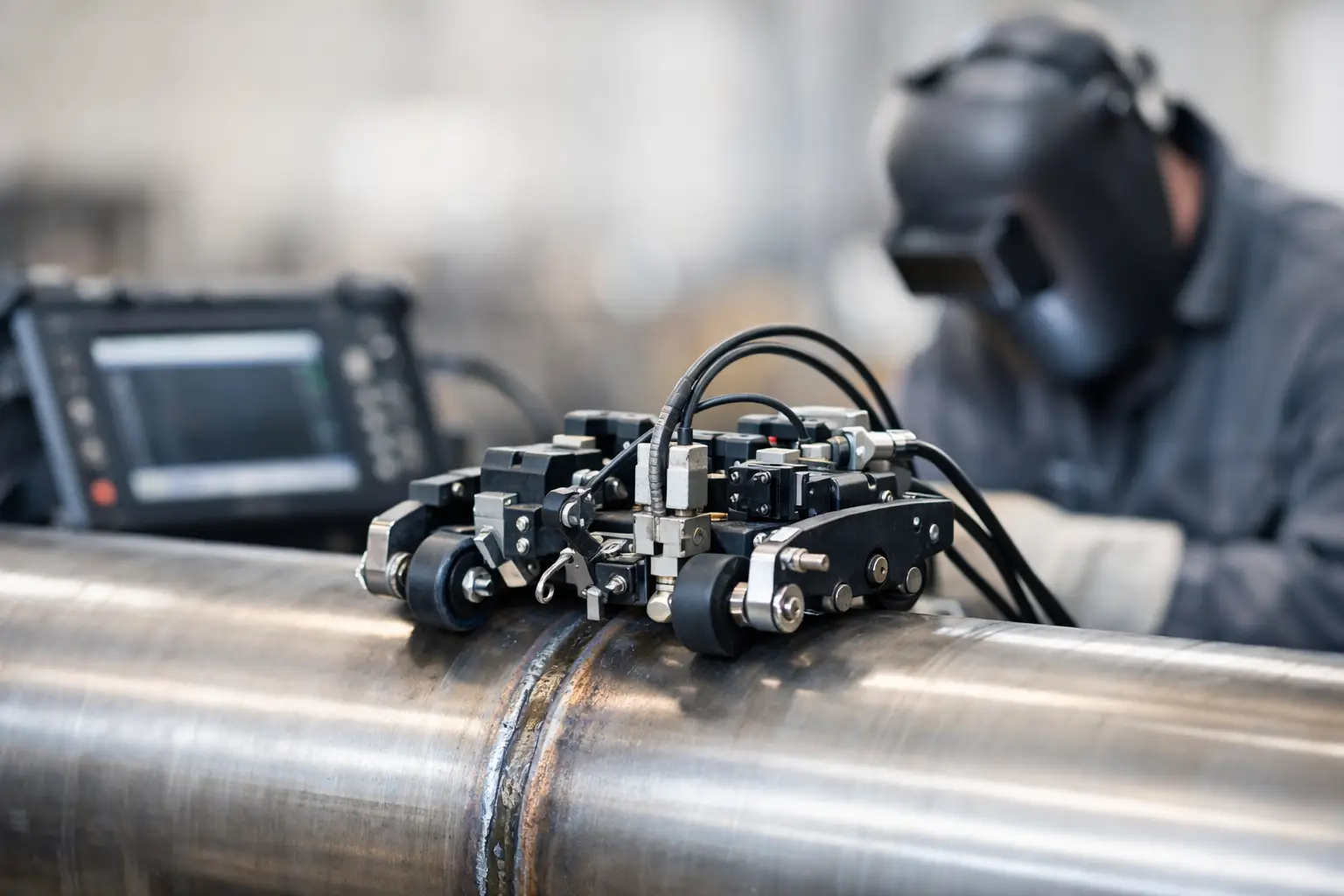

If you have ever burnt half a shift reconfiguring one scanner to suit a different weld, you already know why use dedicated weld scanners is not just a buying question. It is an operations question. On a busy inspection program, the real cost is rarely the scanner on paper. It is the lost time, the inconsistent setup between jobs, and the bottleneck created when one piece of hardware has to do everything.
Why use dedicated weld scanners in real inspection work
The short answer is that dedicated weld scanners are built to do a specific job well, without constant compromise. For PAUT and ToFD work, that matters more than many teams first admit.
A general-purpose scanner can be useful when you are trying to cover a wide range of applications with limited gear. But there is usually a trade-off. You spend more time changing probe holders, adjusting wheel spacing, rebuilding mounts, checking alignment, and confirming the encoder is behaving as expected. None of that adds value to the inspection result. It is just the price of forcing one platform across too many tasks.
A dedicated weld scanner reduces that friction. If the scanner suits the weld geometry, probe arrangement and access conditions from the start, setup gets faster and more repeatable. That helps whether you are inspecting workshop welds, pipe spools, structural fabrication or in-service assets during shutdown work.
The problem with one scanner doing every job
On paper, one premium scanner that handles everything can look efficient. In practice, it often turns into a workshop project that follows you into the field.
Each new weld application tends to mean some level of rebuild. You shift wedges, move probe arms, swap brackets, change wheels, alter spacing or adapt the frame to suit access. Then the next job comes in and you undo it all again. Over time, the scanner spends a lot of its life in transition rather than scanning.
That creates three common problems. The first is downtime. The second is wear and tear from repeated adjustment and transport. The third is inconsistency, especially when multiple technicians are configuring the same unit under time pressure.
For small and mid-sized NDT businesses, that can become a genuine capacity issue. If one scanner is tied up on a job or sitting on the bench being rebuilt, the rest of the team waits. You may have the instruments, the probes and the people, but not the hardware ready to roll.
Dedicated scanners improve repeatability
Repeatability is one of the strongest arguments for purpose-built weld scanning hardware. When the scanner geometry is stable and matched to the application, you remove a lot of setup variation before the inspection even begins.
That matters because PAUT and ToFD are not just about collecting data. They rely on controlled probe positioning, reliable encoder tracking and consistent movement across the weld. If the scanner is awkward on the surface, poorly balanced or only loosely adapted to the job, it can show up in the data. You may still get a result, but you have made the inspection harder than it needs to be.
A dedicated scanner helps keep the setup known and repeatable from one weld to the next. For procedure-driven work, that supports cleaner execution. For field teams, it reduces the chance of small setup differences becoming larger quality issues later.
Faster deployment means more billable work
Most inspection businesses do not struggle because they lack theory. They struggle because site time is limited, labour is expensive and every delay compounds.
Dedicated weld scanners help by reducing setup and changeover time. If a scanner is already configured for a common weld type, technicians can get on with calibration checks and scanning rather than mechanical fiddling. That is useful in the workshop, but it is even more valuable on shutdowns and live maintenance jobs where access windows are tight.
There is also a simple commercial reality here. Time spent rebuilding scanner hardware is not usually the time a client wants to pay for. The quicker your team can move from arrival to data collection, the better your utilisation of both labour and equipment.
For owner-operators and smaller contractors, this can be the difference between handling one job at a time and running multiple jobs without stretching the same hardware past its limits.
Why use dedicated weld scanners instead of constant rebuilds
The answer is not that dedicated scanners are always cheaper in absolute terms. It is that they can be more economical in operation.
A single expensive scanner that is endlessly adapted for different tasks often carries hidden costs. Components wear sooner because they are adjusted more often. Small parts go missing. Field modifications become normal. Transport gets messier because every job needs a different configuration. Eventually, the scanner becomes a compromise machine that technically does many things, but none of them with much efficiency.
By contrast, using multiple task-specific scanners spreads the workload. One unit can stay configured for a particular weld setup while another is ready for a different application. That reduces handling, preserves settings and limits unnecessary mechanical strain.
This is where a modular but dedicated approach makes sense. You do not need a luxury scanner for every possible niche job. You need practical hardware that is affordable enough to deploy where it saves real time, and specific enough to suit the application without constant rebuilding.
Better fit for field conditions
Weld inspections rarely happen in ideal conditions. You are dealing with coatings, awkward access, varying diameters, hot work restrictions, elevated structures, shutdown schedules and surfaces that are far less tidy than the procedure sheet suggests.
Dedicated weld scanners are useful because they can be selected around those realities. A scanner intended for pipe welds behaves differently from one intended for plate or vessel seams. A compact setup for restricted access is not the same as a larger frame intended for stable long-run scanning. Treating those jobs as interchangeable usually creates frustration in the field.
Fit-for-purpose hardware does not remove all challenges, but it helps the scanner stop being one of them. That is a practical advantage, not a marketing one.
The trade-off: when a general-purpose scanner still makes sense
There are cases where a general-purpose scanner remains the right choice. If your workload is highly varied and relatively low volume, one flexible scanner may be the sensible starting point. The same applies if you are testing a new service line and do not yet know which applications will become regular work.
But once patterns emerge, the inefficiencies become easier to spot. If you are repeatedly inspecting similar welds, repeatedly rebuilding the same scanner, or regularly delaying jobs because hardware is tied up elsewhere, that is usually the point where dedicated scanners start paying for themselves.
So it depends on the mix of work, the number of technicians, and how often your equipment is being reconfigured. The issue is not whether a universal scanner can do the job. It is whether it is still the smartest way to run the job.
A practical scaling strategy for NDT teams
For many inspection businesses, scaling does not begin with more staff. It begins with removing bottlenecks.
Dedicated weld scanners can be part of that. Instead of asking one scanner to cover every PAUT and ToFD task, teams can build out a small fleet of purpose-built setups for their most common work. That gives technicians more independence, reduces bench time and makes scheduling easier.
It also lowers the risk tied to a single piece of hardware. If one scanner is damaged, delayed or already deployed, the whole operation does not stop. From a business point of view, that resilience matters just as much as the technical benefit.
This is one reason practical scanner ecosystems have gained traction with working inspection crews. Businesses such as PAUT.Tech have focused on the idea that affordable, task-specific hardware can often deliver better day-to-day value than relying on one premium scanner to cover everything.
What to look for in a dedicated weld scanner
If you are weighing up the switch, look past broad claims and focus on application fit. The right scanner should suit your probe arrangement, weld type, access constraints and surface conditions. It should be easy to deploy, mechanically stable and straightforward to maintain.
Modularity still matters, but in a controlled way. You want enough adaptability to handle real field variation without turning every job into a rebuild. Good dedicated hardware sits in that middle ground. Specific enough to be efficient, flexible enough to be useful.
The best question is not whether a scanner can technically be adapted. It is how often you will need to adapt it, and what that costs your team over a month of real work.
A scanner should help you inspect welds, not become its own side job. If your current setup is slowing down the crew, chewing up bench time or limiting how many jobs you can run at once, dedicated weld scanners are worth a hard look. In this line of work, practical wins usually come from removing small recurring problems before they become expensive habits.