
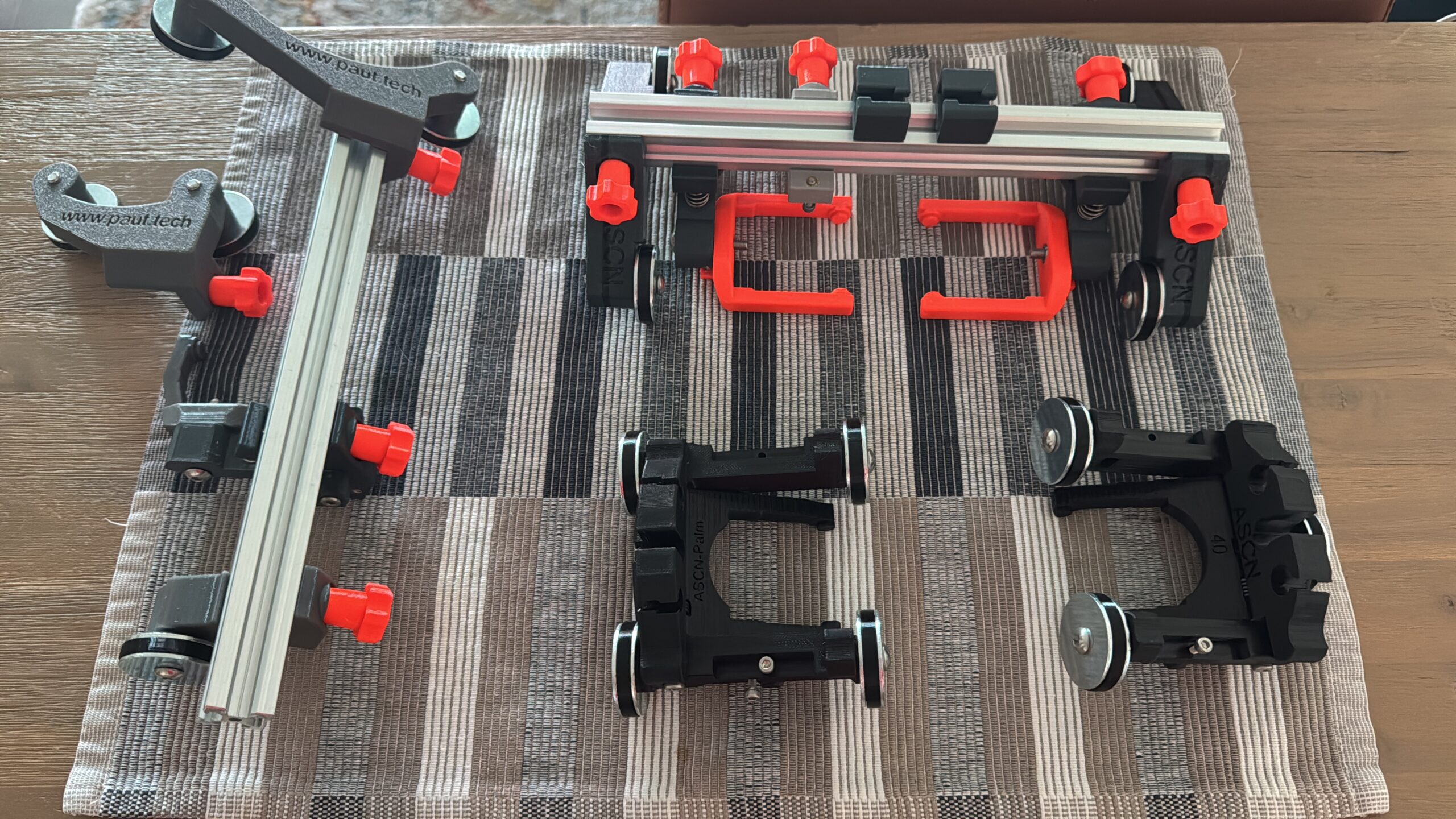

Anyone who has spent a week bouncing between welds, corrosion mapping and pipe work already knows the problem. One scanner might technically cover all three jobs, but if it needs to be stripped down, reconfigured and checked every time the scope changes, it stops being flexible and starts being a bottleneck. That is usually where the question of what makes PAUT scanners modular stops being marketing talk and becomes a practical equipment issue.
A modular PAUT scanner is not just a scanner with a few optional extras bolted on. It is a scanner system built around interchangeable mechanical parts, repeatable mounting points and task-specific accessories that let technicians adapt hardware to the inspection at hand without starting from scratch. The value is not in complexity. The value is in reducing rebuild time, protecting equipment from unnecessary wear and keeping more than one job moving at once.
What makes PAUT scanners modular in practice
In practical terms, modularity comes down to how easily a scanner can be changed to suit probe arrangement, weld geometry, surface condition, travel path and encoder requirements. If a frame accepts different wheel sets, probe holders, wedges, arm configurations and scanning accessories without custom machining every time, that is modular. If those changes can be made quickly and repeated reliably in the field, that is useful modularity.
That distinction matters. Plenty of scanner systems claim flexibility, but some only achieve it by making the base unit complicated and time-consuming to adjust. From an inspection point of view, that is not always a win. A genuinely modular setup should let you configure for a narrow cap weld, then shift to a corrosion scan or circumferential pipe application using compatible components rather than a full workshop rebuild.
The best modular systems usually share a few traits. They use common interfaces across the range, keep mechanical adjustments straightforward, and avoid making every job rely on one oversized scanner body. That last point is often overlooked. In the field, it can be more efficient to have several simpler scanner bodies configured for specific tasks than one expensive unit that is constantly being repurposed.
The core parts that create modularity
The frame is where modularity starts, but it is not where it ends. A scanner frame needs enough mounting options to support different probe positions and scanning layouts, while still staying rigid under normal operating conditions. Too much movement in the frame creates data quality issues. Too little adaptability turns the scanner into a single-purpose tool.
Probe holders and wedge mounts are another major part of the equation. PAUT work rarely lives in a perfect, standardised world. Probe sizes vary, wedge styles vary, and scan plans often need fine adjustment to meet procedure requirements or access restrictions. Modular holders allow those changes without forcing technicians into improvised brackets or one-off parts.
Wheel assemblies and contact geometry also play a big role. A scanner that accepts different wheel types or spacings is easier to match to curved pipe, flat plate, narrow weld crowns or rougher surfaces. That does not mean one scanner should be expected to handle every surface equally well. It means the hardware ecosystem should let the operator choose the right running gear for the task.
Encoder integration is often where good modular design shows its worth. If encoder mounting is treated as an afterthought, every change to the scanner can create alignment issues or tracking inconsistency. In a modular system, encoder placement should stay stable and repeatable across different configurations, otherwise setup speed is lost to recalibration and checking.
Why modular scanners matter on real jobs
Field work punishes any equipment that looks good on paper but needs too much fiddling. Inspection crews are dealing with access limitations, shutdown windows, weather, coating condition and site pressure. A modular scanner helps because it shortens the path from arriving on site to collecting usable data.
That benefit shows up first in setup time. If you can swap a holder, adjust a wheelbase and mount a different probe arrangement in minutes, the crew spends less time building hardware and more time scanning. That is especially relevant for small service companies and owner-operators, where one delayed setup can affect the whole day.
It also matters for equipment availability. When a business owns one premium scanner that must cover every application, every inspection competes for the same hardware. A modular product ecosystem makes it easier to spread capability across multiple scanners without the same capital hit. Instead of one scanner being rebuilt for every task, separate units can stay configured for weld scanning, corrosion work or pipe jobs.
There is also a wear-and-tear argument. Constant rebuilds are hard on threads, clamps, brackets and cable management. Even good equipment suffers if it is repeatedly taken apart to suit different jobs. Modularity reduces that strain because the system is designed for controlled change, not endless improvisation.
What makes PAUT scanners modular without making them overcomplicated
There is a point where modularity turns into clutter. More parts do not automatically mean more capability. If a technician needs a manual to work out every basic adjustment, the design has missed the mark.
Useful modularity keeps the logic obvious. Components should fit where you expect them to fit. Adjustments should be repeatable. Left and right side changes should not require two completely different methods. In a good design, the scanner can be adapted by someone who understands inspection work, not just someone who built the hardware in the workshop.
This is where engineer-led design matters. The scanner needs to reflect how inspections actually happen - changing probe offsets, dealing with clearance limits, setting up on awkward weld caps, swapping between encoded applications and trying to keep jobs moving with the gear available in the ute. A modular scanner that ignores those realities tends to look versatile in a catalogue and frustrating on site.
The trade-off: modularity versus purpose-built simplicity
Not every job needs the most adjustable scanner possible. Sometimes the right answer is a purpose-built unit that stays configured for one inspection style and does that job well. That does not contradict modularity. In many cases, modular design works best when it supports a family of task-specific scanners rather than forcing one scanner to be everything at once.
That is an important distinction for buyers. If your workload is mostly one type of weld scan, a simpler dedicated setup may be the smarter choice. If your work shifts between encoded welds, corrosion mapping and small-diameter pipe, modularity starts to earn its keep very quickly. It depends on how often your team changes applications, how many crews are sharing equipment and how much downtime a rebuild creates.
Cost sits in the middle of that decision. Traditional scanner buying logic often pushes businesses towards one expensive unit with broad claimed capability. On paper, that can look efficient. In practice, it can create a single point of failure and a constant rebuild cycle. A more modular, practical approach can spread risk and make scaling easier, especially for growing inspection businesses.
How to assess whether a scanner is truly modular
The quickest way to assess modularity is not to ask how many accessories exist. Ask how the scanner changes between real applications. Can the probe mounting arrangement be altered without custom parts? Can the same base components support different scan widths or geometries? Can the scanner be reconfigured quickly enough that it saves time rather than consuming it?
It is also worth looking at part compatibility across the range. If accessories only work with one exact frame, the system may be expandable but not truly modular. The stronger approach is shared components across multiple scanner types, so existing parts keep their value as your inspection needs grow.
Durability should stay in the conversation too. Modular hardware still has to survive transport, handling and repeated field use. If the design relies on delicate adjustment features that drift or wear prematurely, the modular concept will not hold up for long. Practical modularity is not about maximum adjustability. It is about repeatable adaptability under working conditions.
For many inspection teams, that is the real answer to what makes PAUT scanners modular. It is not one clever feature. It is a design philosophy where scanner frames, holders, wheels, encoders and accessories are built to work together in a way that matches actual inspection demands. The result is less rebuilding, better equipment utilisation and a setup that can grow with the work instead of slowing it down.
For crews trying to do more with limited time and budget, that matters more than any premium badge. The best scanner is the one that fits the job, stays practical in the field and does not make tomorrow's setup harder than it needs to be.