
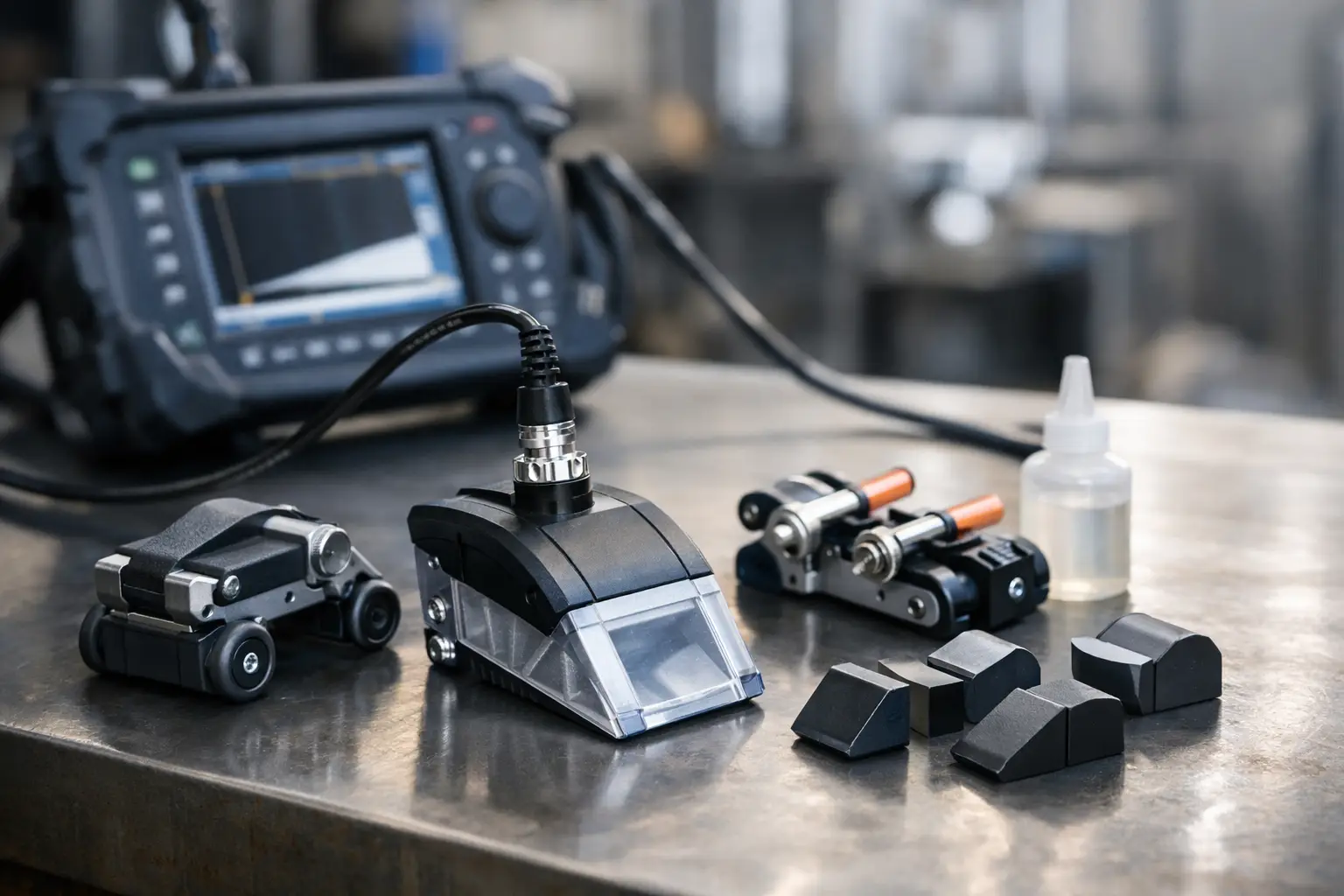

A wedge that works well on the bench can still be the weak point on site. The problem usually is not the wedge body itself. It is the small hardware around it - the mounting parts, guide elements, wear items and adapters that decide whether your scan runs cleanly or turns into a stop-start setup exercise. That is where PAUT wedge accessories earn their keep.
For inspection teams running weld scans, corrosion mapping or mixed jobs across a shutdown, accessories are not an afterthought. They affect probe alignment, encoder consistency, contact stability and how quickly one setup can be turned into the next. If the accessory set is wrong, technicians end up improvising with whatever is in the kit. That costs time, adds variation and usually shows up later in data quality.
Why PAUT wedge accessories matter on real jobs
Most technicians have seen the same pattern. The scanner is capable enough, the instrument is configured properly, but the mechanical setup is fighting the operator. A wedge sits at the wrong height, the probe position needs shimming, the wear surface drags, or the mounting arrangement is too awkward for the geometry being inspected. None of that looks dramatic in the workshop, but it matters when you are working around coating edges, clamps, crown variation or limited access.
Good PAUT wedge accessories solve practical problems before they become inspection delays. They let you match the wedge and probe arrangement to the scan task instead of forcing every job into one fixed configuration. That is particularly useful for service companies juggling butt welds one day, nozzle work the next, and encoded corrosion work after that.
There is also a cost angle that gets overlooked. When operators keep rebuilding one scanner with makeshift hardware, wear increases and repeatability drops. Accessories that are designed to suit specific wedge and scanner combinations reduce that churn. You spend less time modifying setups and more time collecting usable data.
What the right accessory set actually changes
The biggest gain is usually setup speed. If a wedge can be mounted, aligned and adjusted without trial-and-error, the technician gets to calibration and scanning faster. That sounds basic, but over a week of field work it adds up quickly.
The second gain is consistency. Mechanical repeatability matters in encoded PAUT. If probe position or wedge tracking changes from scan to scan, your data can still be interpretable, but comparison becomes harder and confidence drops. Accessories that hold geometry properly help keep scan conditions stable.
The third gain is adaptability. Not every job justifies a full scanner rebuild. Sometimes the smartest move is to change the wedge support, swap a guide component, adjust the mounting offset or use a different wear item. A modular accessory approach gives you that option without turning a simple change into a half-hour job.
Common types of PAUT wedge accessories
In practice, accessories tend to fall into a few useful categories. Mounting adapters are the obvious one, because they connect the wedge and probe assembly to the scanner in a way that preserves alignment and travel. Then there are positioning and guide parts that help maintain contact and tracking over the surface being inspected.
Wear components matter more than many crews admit. If the contact surface is worn unevenly or the guiding element has too much play, the scan may still run, but not as cleanly as it should. Small mechanical errors are easy to tolerate when you are rushing. They are harder to justify when the data review starts.
Cable management parts are also part of the accessory picture, even if they do not get much attention. Poor cable routing pulls on the wedge, affects tracking and creates avoidable handling issues. A tidy, restrained cable path can make a scanner feel more stable straight away.
Choosing wedge accessories for weld scanning
Weld scanning usually exposes poor accessory choices quickly. Access around caps, toes and adjacent geometry can be limited, and the scanner has to carry the wedge in a way that stays steady across the scan length. If the accessory arrangement sets the wedge too high, too far out, or with too much movement, the operator ends up compensating by hand.
For girth welds and pipe work, compactness matters. Extra bulk around the wedge can interfere with adjacent hardware or make the scanner awkward on smaller diameters. For plate welds, the priority may shift toward smooth travel and consistent offset. The point is that the accessory choice should follow the inspection geometry, not the other way around.
If you regularly scan a mix of weld types, modular accessories are usually the better long-term option than a single fixed arrangement. They may involve a bit more planning when you first build the kit, but they reduce rebuild time across repeated jobs.
When a simple setup is the better setup
Not every scan needs a highly configurable arrangement. For repetitive weld inspection in known conditions, a simpler accessory combination can be the better call. Fewer adjustable parts often means fewer opportunities for movement, wear and misalignment.
That trade-off matters. Maximum flexibility is useful, but it can also create extra setup variables. If a crew is doing the same application every week, a dedicated configuration is often more efficient than carrying every possible option.
PAUT wedge accessories for corrosion and encoded mapping
Corrosion work places different demands on the wedge setup. Here the focus is often less about weld geometry and more about stable encoded travel over broader surfaces. The accessory set needs to help the wedge maintain contact, manage movement smoothly and avoid introducing unnecessary drag.
Surface condition changes the equation. Painted plate, scaled steel and rougher service surfaces all affect how a wedge behaves in motion. Accessories that improve support and tracking can make the difference between a scan that feels controlled and one that constantly needs correction.
This is also where affordability matters in a very practical sense. If your business can field multiple task-specific scanner setups rather than cannibalising one premium unit for every job, throughput improves. That is a big part of why purpose-built, modular hardware has gained traction with smaller and mid-sized inspection teams.
What to look for before you buy
Start with compatibility, but do not stop there. An accessory can technically fit a wedge or scanner and still be frustrating in use. Check how adjustment works, how secure the mounting is, and whether the design supports repeatable positioning in the field.
Material choice matters as well. Accessories need to be light enough to keep the scanner practical, but not so light or flexible that they compromise rigidity. This is especially relevant with 3D-printed hardware and hybrid assemblies. Good engineering here is less about chasing prestige and more about balancing weight, durability and replaceability.
It is worth thinking about serviceability too. Field hardware gets knocked around. If an accessory can be replaced quickly without retiring the whole setup, that is usually a better operational outcome than a polished part that is expensive or slow to replace.
Questions worth asking
Before adding new wedge accessories to your kit, ask three things. Does this reduce setup time on the jobs we actually do? Does it improve scan stability or repeatability? And can it be deployed by the crew without special workarounds? If the answer is no to all three, it is probably not solving a real problem.
Avoiding the usual mistakes
A common mistake is overbuilding the setup. Technicians sometimes add brackets, offsets and adapters because they might be useful later. The result is a wedge assembly that is heavier, more awkward and less stable than it needs to be.
Another mistake is treating accessories as universal. A part that works well for one wedge angle, one probe size or one scanner frame may be a poor fit elsewhere. Standardising where it makes sense is smart. Assuming one accessory suits every application usually is not.
The last issue is neglecting wear. Accessories often stay in service longer than they should because the scanner still moves and the data still looks acceptable. But small amounts of movement or surface wear can steadily reduce consistency. Routine checks save a lot of second-guessing later.
For inspection businesses trying to get more work through the door without tying up capital in oversized scanner systems, wedge accessories are a practical place to improve performance. The best ones do not make a lot of noise. They just make the setup easier, the scan steadier and the day less dependent on improvised fixes. That is usually what good inspection hardware is supposed to do.