
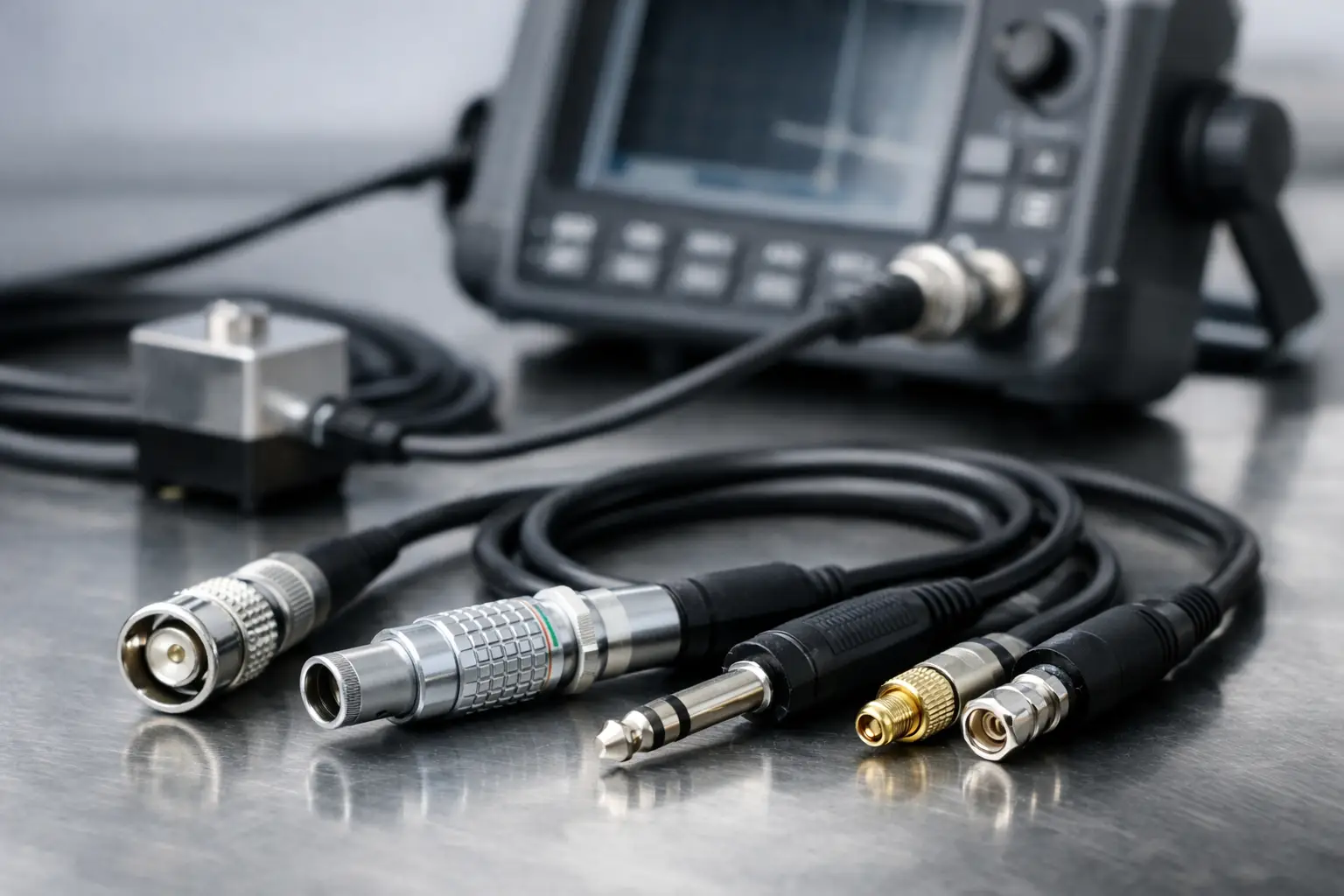

Adapter cables for ultrasonic testing rarely get much attention until a job stalls because the probe lead does not match the instrument, the pinout is wrong, or the connection starts dropping out halfway through a scan. Most technicians have been there. You can have the right PAUT setup, a suitable scanner, and a clear inspection procedure, but if the cable chain between probe and unit is wrong, the whole inspection slows down fast.
That is why cable selection should be treated as part of the inspection setup, not as an afterthought. In PAUT and ToFD work, adapter cables are not just convenience items. They are what let different probes, wedges, scanners and instruments work together in the field without forcing unnecessary rebuilds or improvised fixes.
What adapter cables for ultrasonic testing actually do
At a basic level, adapter cables for ultrasonic testing allow one connector format, pin configuration or equipment type to interface with another. That sounds simple enough, but in practice there is a fair bit riding on that connection.
In ultrasonic inspection, particularly with phased array systems, you are often working across mixed equipment fleets. A probe may be built for one connector standard while the instrument or scanner loom is set up for another. A ToFD pair may need a different arrangement again. Without the correct adapter, the hardware might not connect at all, or worse, it may connect physically while introducing channel mismatch, intermittent signal loss or confusion during setup.
A good adapter cable preserves function, maintains signal integrity as far as practical, and reduces the need to carry duplicate probes or rebuild an entire scanner arrangement just to suit one instrument. For a service company juggling multiple jobs, that matters.
Why the wrong cable costs more than the cable itself
Most inspection teams do not lose money because an adapter cable is expensive. They lose money because a poor cable choice wastes site time.
The obvious cost is delay. If a technician arrives on site and discovers the phased array probe cannot be connected to the available unit, the job can slip immediately. Sometimes there is a workaround in the kit. Sometimes there is not. Either way, the client is not paying for improvisation.
The less obvious cost is diagnostic confusion. When signal quality is poor, teams quite reasonably look first at wedge condition, couplant, probe wear, scanner alignment or instrument settings. If the actual issue is an unsuitable or damaged adapter cable, time gets burned chasing the wrong fault. On corrosion mapping or encoded weld scanning, that can mean repeated setup checks before anyone finds the real problem.
There is also the wear factor. Repeatedly forcing temporary cable solutions into a field setup tends to strain connectors, shorten lead life and create more points of failure. That is one reason practical inspection teams prefer to keep task-specific accessories ready to go rather than rebuild one shared setup over and over.
Where cable compatibility usually goes wrong
Not every compatibility issue is dramatic. More often, it is a stack of small mismatches that create trouble.
Connector type is the first one. A probe lead and instrument input may be mechanically different even if they look close enough at first glance. Pin count and pin arrangement are next. Then there is channel mapping, which becomes especially important in PAUT where element assignment has to be correct for the scan plan and software setup to make sense.
Cable length also matters more than people sometimes allow for. Too short and the setup becomes awkward on a pipe scanner or weld scanner. Too long and the extra lead can become a nuisance on site, particularly when working around stands, lifting gear or elevated structures. Longer runs can also introduce practical handling issues even when electrical performance is acceptable.
Shielding and build quality matter as well. A cable that is fine in a workshop may not last long in the field where it is dragged across plate, bent around pipe, packed into hard cases and exposed to dust, moisture and rough handling in the back of a ute.
Choosing adapter cables for ultrasonic testing in real jobs
The right cable depends on the application, not just the connector at each end. That is the part worth slowing down for.
If you are running PAUT weld inspections, your priority is often reliable channel continuity and a cable layout that does not fight the scanner. If the lead exits awkwardly or places strain on the probe connection, the setup becomes harder to manage than it needs to be. On encoded scans, mechanical practicality is just as important as electrical compatibility.
For ToFD work, pair consistency and dependable connections are critical because setup errors can affect sizing confidence very quickly. In that context, a cable that simply fits is not enough. You want one that supports repeatable deployment without second-guessing what is happening between instrument and probe.
For corrosion mapping or thickness-related applications, the environment tends to influence the decision more heavily. Long days, repetitive movement, wet surfaces and frequent repositioning can be harder on cables than the inspection technique itself. Durability becomes a bigger part of value.
This is where a modular equipment philosophy helps. If you run multiple scanners or keep dedicated rigs for different jobs, well-matched adapter cables allow each setup to stay ready for its intended task rather than being stripped apart to solve the next compatibility problem.
What to look for before you buy
The first question is straightforward: what exactly are you adapting? Probe to instrument, scanner loom to instrument, or one probe standard to another connector format? Be specific. Vague compatibility assumptions are where purchasing mistakes usually start.
Next, confirm the connector types and pinout requirements. This should be checked against the actual equipment in service, not a guess based on what was used on a previous job. Similar-looking connectors have caused plenty of unnecessary headaches.
Then look at the job conditions. If the cable will live mostly in a workshop kit, one build style may be enough. If it is heading into shutdown work, fabrication yards or mine-site inspection, you want something that can tolerate repeated handling and transport. Strain relief, jacket toughness and connector protection are not glamorous features, but they are often what separates a useful cable from a short-lived one.
Length should be chosen with restraint. Extra length sounds safe until it starts snagging on scanner frames or creates cable management issues near the scan area. The shortest practical length that still suits the real setup is usually the better choice.
Why standardisation helps small inspection teams
For owner-operators and smaller NDT businesses, cable standardisation can save more grief than chasing the lowest purchase price each time. If your team knows which adapters belong with which scanners, probes and instruments, mobilisation gets simpler and setup errors drop.
This is especially relevant when one business is running a mix of legacy hardware and newer equipment. Adapter cables can extend the usefulness of existing probes and accessories, but only if that compatibility is organised properly. Random cable accumulation does not scale well. A documented, repeatable approach does.
That does not mean every fleet should be forced into one standard. Sometimes mixed equipment is the practical reality. The smarter approach is to make those interfaces deliberate, labelled and job-ready.
A practical approach to cable management
Good adapter cables earn their keep when they are easy to identify, easy to inspect and easy to replace. That points to a simple system: label them clearly, keep them assigned to the setups that use them most often, and inspect them like any other working accessory.
Connector wear, loose locking sections, jacket damage and intermittent faults should be treated seriously. Cables tend to fail progressively before they fail completely. If a lead only drops out when bent a certain way, it is already telling you it is on borrowed time.
For businesses building out multiple fit-for-purpose scanner kits, this is where practical accessory planning matters. A scanner may be purpose-built for a weld profile or pipe diameter, but the setup is only truly ready if the cable path is sorted as well. That is part of the reason specialist suppliers such as PAUT.Tech focus on accessory compatibility as part of a working inspection ecosystem, not as a side item.
The cable is small, but the decision is not
In ultrasonic inspection, small hardware choices often control whether a job starts smoothly or turns into half an hour of avoidable troubleshooting. Adapter cables sit squarely in that category. They are not the centrepiece of a PAUT or ToFD setup, but they quietly decide how easily the rest of the kit can do its job.
If a cable lets you keep probes in service, match scanners to the right instrument, and reduce rebuild time between jobs, it is doing more than bridging connectors. It is protecting utilisation, reducing downtime and keeping the inspection crew focused on the scan rather than the setup.
When you are packing for the next job, the best adapter cable is usually the one you do not have to think about because it fits, works, and stays out of the way.