
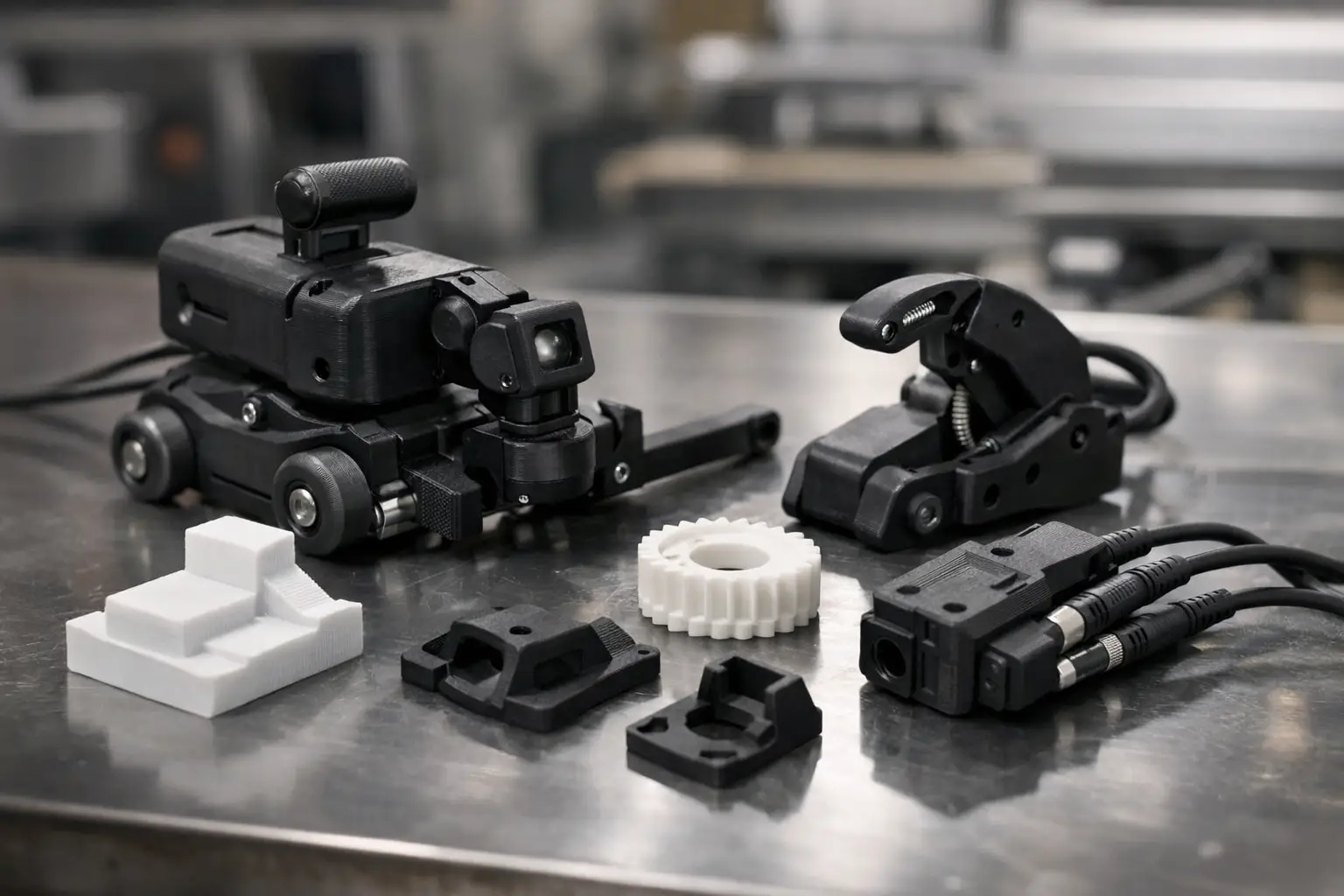

When a crew is held up because the only scanner in the kit needs another rebuild for a different weld, the problem is not usually the probe or the instrument. It is the hardware around the job. That is where 3d printed NDT scanner parts have started to make real sense for field inspection teams, especially in PAUT and ToFD work where setup time, repeatability and access all matter.
The value is not novelty. Most NDT technicians do not care how a part is made if it tracks properly, holds alignment and survives site conditions. What matters is whether the scanner hardware suits the inspection task without forcing a compromise. A compact weld scan on one day and a pipe corrosion mapping job on the next often need different frame layouts, wheel positions, probe holders or accessory mounts. Traditional scanner systems can do the job, but they often do it by making you reconfigure one expensive platform over and over again.
Why 3D printed NDT scanner parts are gaining ground
The main shift is practical. Additive manufacturing lets scanner parts be designed around inspection use rather than around the limits of traditional machining. That means a bracket can be shaped for a specific wedge angle, an encoder mount can sit where it needs to sit, and a frame component can be kept light without becoming flimsy.
For NDT businesses, the bigger advantage is cost structure. If every scanning task depends on one premium scanner body with a pile of rework between jobs, capacity gets choked by hardware availability. Purpose-built parts change that. Instead of asking one scanner to be everything, teams can keep several task-specific setups ready to go.
That does not mean every printed part is automatically fit for industrial use. Material choice, wall thickness, fastening design and wear surfaces still need proper engineering. A part that looks good on a bench can fail quickly if it is carrying load through the wrong axis or rubbing against scale, slag or rough coating all day. The benefit comes from good design discipline, not from printing alone.
Where 3D printed NDT scanner parts work best
The strongest use case is scanner hardware that needs to be application-specific but not unnecessarily complex. Probe holders, wedge carriers, guide blocks, encoder mounts, cable retainers and modular frame sections are obvious examples. These are the parts that usually need slight changes between jobs, and they are also the parts that can waste the most time when a team is improvising with generic hardware.
In PAUT weld scanning, printed components are especially useful where probe placement and repeatability matter more than cosmetic finish. A holder that keeps wedge position consistent across a weld run is worth more than an overbuilt assembly that takes half an hour longer to adjust. In ToFD, spacing and alignment are critical, so the design must be stable and predictable. If the part is engineered properly, additive manufacturing can deliver that repeatability without pushing the price of the whole scanner out of reach.
Pipe work is another area where modular printed components make a lot of sense. Diameter changes, varying access and attachment methods can turn a standard scanner into a compromise very quickly. A modular approach lets you swap the parts that need to change while keeping the rest of the system familiar to the technician.
The real operational benefits
The first benefit is faster deployment. If the scanner is already built for the task, the technician spends less time on the tailgate or in the crib room sorting out wheel positions, arm lengths and accessory clashes. That matters when a shutdown schedule is tight or the client is waiting on scan results.
The second benefit is lower capital pressure. Many small and mid-sized inspection businesses do not need one prestige scanner that tries to cover every scenario. They need enough hardware to keep crews moving. Printed scanner parts make it more realistic to build out a small fleet of job-specific setups rather than sink budget into a single high-cost unit.
The third benefit is reduced wear from constant rebuilding. Every time a scanner is stripped and reassembled, threads wear, parts get misplaced and alignment can drift. Keeping multiple setups ready for common tasks reduces handling and preserves the hardware.
There is also a training advantage. When a scanner stays configured for a known application, procedures become easier to standardise. The operator knows where the encoder sits, how the probe holder behaves and what to check before scanning. That consistency can matter just as much as the scan itself.
The trade-offs with 3D printed NDT scanner parts
There are trade-offs, and they should be stated plainly. Printed parts are not the right answer for every component. High-wear contact surfaces, heavily loaded axles and parts exposed to excessive heat or aggressive chemicals may still be better handled with metal or other conventional materials.
Surface finish can also affect how a part performs if tolerances are poorly controlled. A printed frame section with slight distortion may be acceptable in one application and unacceptable in another. For that reason, critical interfaces need to be designed with realistic tolerances and, where necessary, paired with machined inserts, bearings or fasteners.
Environment matters as well. A workshop trial is one thing. Offshore splash zones, hot pipework, abrasive dust and rough transport in the back of a ute are another. Good scanner hardware has to account for how technicians actually work, not how a product photo looks on a clean bench.
This is why engineer-led design matters. The question is not whether a part is printed. The Question is whether it has been designed for field loading, repeat setup and inspection accuracy.
What to look for in 3D printed NDT scanner parts
A useful part should solve a field problem first. If it exists only because it can be printed, it is probably not adding much value. The better approach is to start with the job requirement - probe position, wheel tracking, encoded movement, pipe diameter range, weld cap clearance - and then choose the manufacturing method that delivers the result.
Material selection should match the application. Some parts need stiffness. Others need impact resistance or a bit of compliance. Fastening design also matters. Threads directly into printed plastic may be fine in some areas, but repeated adjustment points often need inserts or captive hardware to stay reliable.
Modularity is another strong indicator of good design. In practical NDT work, accessories need to be swapped without rebuilding the entire scanner. If a frame can accept different probe holders, wheel sets or mounting options, the hardware is more likely to stay useful across changing work scopes.
Finally, inspectability should not be ignored. A technician should be able to look at the part and understand wear points, adjustment points and likely failure points. Overcomplicated assemblies are rarely the friend of field reliability.
Why fit-for-purpose matters more than premium branding
A lot of scanner hardware in the market is built around the idea of one high-end system doing everything. That sounds efficient until the scanner becomes a bottleneck across multiple jobs. Inspection businesses often do better with practical hardware that can be assigned to the job and left configured for it.
That is where companies like PAUT.Tech have a clear lane. The value is not in pretending printed hardware is luxury equipment. The value is in building scanner parts and assemblies that suit real PAUT and ToFD tasks, keep cost under control and let businesses expand capability without overloading one scanner platform.
For many teams, that is the smarter operational decision. More available hardware, less rebuild time, and less strain on the gear that earns its keep every day.
3D printed NDT scanner parts and the future of inspection hardware
The direction is fairly clear. NDT hardware is moving towards modular systems with more application-specific accessories, faster turnaround on design updates and a better match between scanner layout and inspection task. Additive manufacturing supports that shift because it allows practical iteration without dragging every small design change through long production cycles.
That does not replace sound engineering. If anything, it makes engineering judgement more important. The easier it is to make a part, the more discipline is required to make the right part.
For inspection businesses trying to balance performance, cost and uptime, that is the real point. 3d printed NDT scanner parts are not valuable because they are new. They are valuable when they remove friction from the job, keep technicians productive and make it easier to put the right scanner on the right weld, pipe or corrosion run at the right time.
The best hardware is rarely the most glamorous. It is the gear that turns up, fits the task and lets the crew get on with the scan.