
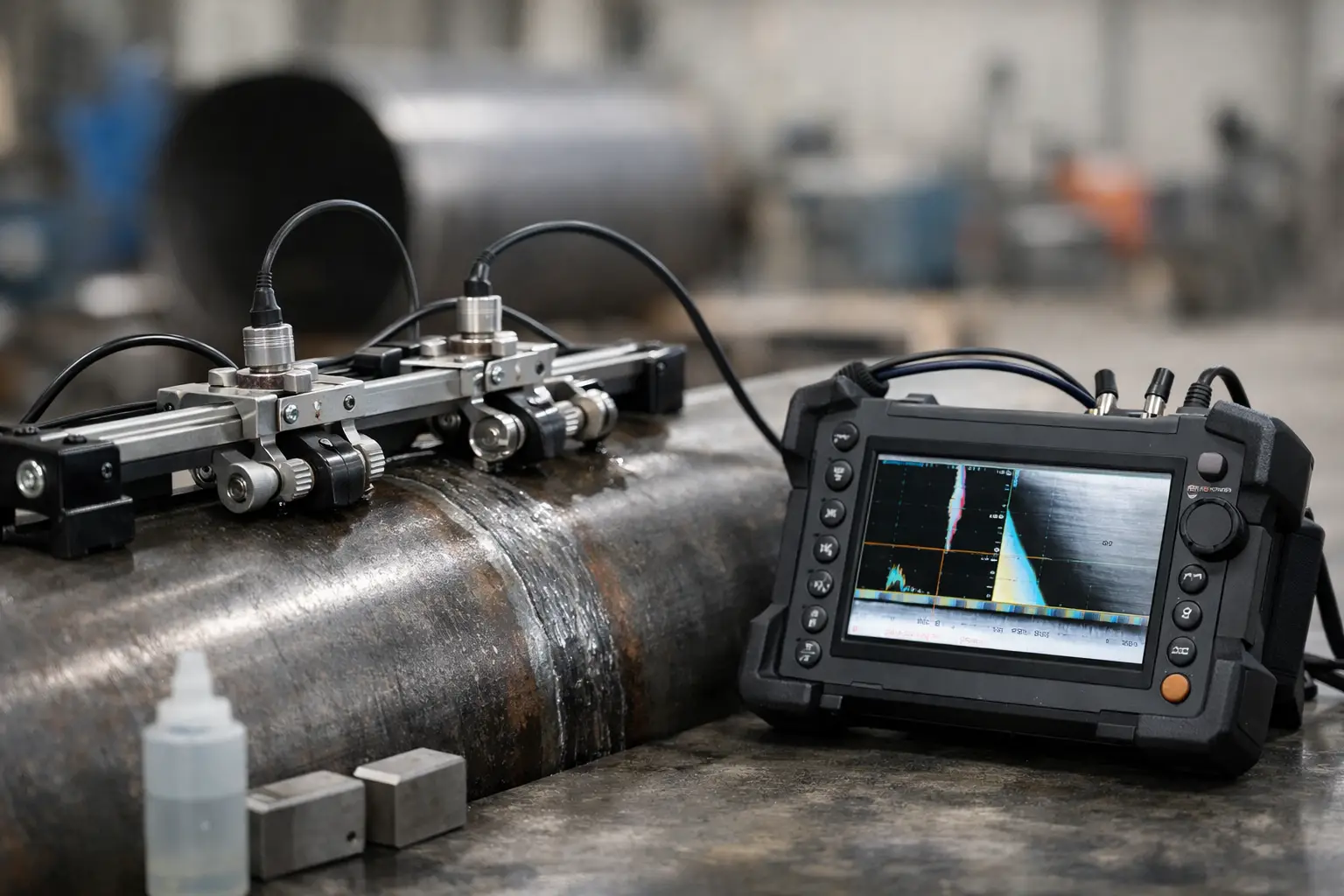

If you have ever tried to explain a ToFD setup to someone outside NDT, you know the problem straight away. People hear “equipment” and picture a single instrument. In practice, what is ToFD inspection equipment really referring to is a working system - probes, wedges, scanner, encoder, cabling and acquisition unit - all set up to capture usable diffraction data on a real weld, not just produce a tidy bench-top demo.
For technicians and inspection businesses, that distinction matters. A ToFD job can be fast, repeatable and highly effective, but only when the hardware is matched to the application. If one part of the setup is wrong - wedge angle, probe spacing, scanner stability, encoder tracking, cable management - the inspection slows down or the data quality suffers.
What is ToFD inspection equipment in practical terms?
Time of Flight Diffraction inspection equipment is the hardware used to perform ultrasonic weld examination by detecting diffracted signals from flaw tips rather than relying only on reflected amplitude. The method is well established for weld inspection because it can size defects accurately, especially through-wall height, when the setup is correct.
In practical field terms, ToFD inspection equipment usually includes a pair of longitudinal wave probes, matching wedges, a scanner to hold probe separation and keep movement controlled, an encoder to record positional data, cables, and an ultrasonic instrument or flaw detector capable of ToFD acquisition and imaging.
That means the “equipment” is not one box. It is the full mechanical and electronic chain required to place probes consistently, move them across the weld, and record trustworthy data. If the job involves circumferential welds, odd geometry, restricted access, painted surfaces or elevated temperatures, the mechanical side becomes just as important as the electronics.
The core parts of a ToFD setup
At the heart of the setup are two probes arranged on opposite sides of the weld. One transmits and the other receives. Instead of looking mainly for high-amplitude reflections, ToFD interprets the arrival times of lateral wave, backwall signal and diffraction from discontinuity tips. That is what gives the technique its sizing strength.
The wedges set the beam angle into the material and help establish the inspection geometry. Probe frequency, element size and wedge choice depend on material thickness, weld profile and expected flaw types. There is no universal combination that suits every weld. A setup that works well on one wall thickness may be a poor choice on another.
The scanner is what keeps the system honest. It holds the probe pair at a fixed separation, keeps the travel path aligned and reduces the variability that comes from hand placement. On straight welds this may be a compact manual scanner. On pipe or curved surfaces, it may be a purpose-built frame or band-mounted arrangement that tracks properly around the circumference.
The encoder records distance travelled so the instrument can map indications against scan position. Without reliable encoder feedback, the data becomes harder to interpret and reporting loses confidence. This is why slippage, poor wheel contact or unstable mounting can turn a straightforward inspection into a frustrating one.
Then there is the instrument itself. The flaw detector or acquisition unit generates the pulse, receives the signals and displays the B-scan image. Some crews run combined PAUT and ToFD systems, which is common on weld procedures where both methods are used together. In those cases, the scanner design often needs to support multiple probe configurations without becoming bulky or awkward to deploy.
Why scanner hardware matters more than many people expect
On paper, ToFD can sound probe-and-instrument driven. In the field, mechanical stability often decides whether the method is efficient or painful.
A good ToFD scanner needs to do a few simple things reliably. It needs to maintain probe offset, keep contact consistent, survive rough handling and move across the weld without introducing encoder errors. That sounds basic, but anyone who has had to rebuild a scanner on the tailgate of a ute between jobs knows how quickly “basic” becomes expensive.
This is where fit-for-purpose hardware matters. If your team is constantly reconfiguring one premium scanner to cover every weld, every pipe size and every mixed PAUT/ToFD job, you lose time and add wear. The more sensible approach is often to use task-specific hardware that can be deployed quickly and kept ready for the jobs it actually does.
That does not mean the most expensive scanner is always the best option. For many inspection businesses, especially smaller operators, practical modular hardware gives better return because it expands job capacity without forcing one scanner to do everything badly.
How ToFD equipment is used on site
A typical weld inspection starts with selecting the correct probe pair and wedge combination for the wall thickness and code requirement. The scanner is then set to the required probe centre spacing, encoder operation is checked, and the system is calibrated on the appropriate reference block or procedure-defined setup.
Once on the weld, the scanner guides both probes along the inspection line while the instrument records the scan. The operator watches for clean lateral wave and backwall responses, confirms coverage through the weld volume and checks whether geometric features or cap profile are affecting coupling or interpretation.
This is where real-world trade-offs appear. A compact scanner may be easier to use in tight access, but it might offer fewer adjustment options. A larger frame may hold geometry better over long scans, but be slower to mount and remove. Magnetic wheels can help on some carbon steel applications, while non-magnetic or coated surfaces may call for a different approach.
On pipe welds, curvature adds another layer. Probe alignment, contact pressure and encoder tracking become harder to manage, especially on smaller diameters. Purpose-built pipe scanners and adaptable mounting options make a genuine difference here because they reduce setup variability and operator fatigue.
What ToFD inspection equipment is not
It is not just a probe set. It is not just a flaw detector with a ToFD menu. And it is not a one-size-fits-all scanner package that magically covers every weld you will ever inspect.
That misunderstanding causes plenty of issues during purchasing. Some buyers focus heavily on the electronics and treat scanner hardware as an accessory. Then they get to site and realise the job is being limited by poor tracking, awkward mounting or the inability to hold a repeatable probe separation on the weld type they inspect every week.
A better way to think about ToFD equipment is as a workflow tool. The question is not only whether it can generate ToFD data, but whether it can do it consistently across your normal job mix without constant rebuilding.
Choosing equipment for your inspection work
If your work is mostly plate welds in fabrication shops, the priority may be a simple scanner that is fast to set up, easy to adjust and reliable over repeated straight-line scans. If you spend more time on shutdown work, pipework or site-based maintenance, modularity becomes more valuable because access and geometry change from one job to the next.
Durability matters too. Scanner hardware gets knocked around, thrown in the boot, carried up ladders and used in less-than-perfect conditions. Lightweight is useful, but not if it comes at the cost of poor stability. Likewise, adjustability is valuable, but not if every change needs tools, extra parts and twenty minutes of workshop time.
This is why many inspection teams are moving towards dedicated scanner hardware for specific tasks rather than relying on one heavily shared unit. It improves availability, reduces rebuild time and lowers the operational risk of having one scanner tied up while another crew is waiting. That practical approach is a big part of how PAUT.Tech looks at scanner design for PAUT and ToFD work.
Where ToFD fits alongside PAUT
For many weld inspections, ToFD is not working alone. It is paired with PAUT because the two methods complement each other. ToFD can provide excellent defect sizing and detection of certain planar flaws, while PAUT offers flexible beam steering and stronger characterisation in complex geometries.
That combined approach affects equipment selection. If one scanner can accept both PAUT and ToFD configurations without becoming cumbersome, the crew gains efficiency. But there is still a balance to strike. Overcomplicated universal hardware can slow everything down. Often the better result comes from modular gear that supports the inspection method properly without trying to be all things on every job.
The useful way to answer “what is ToFD inspection equipment” is this: it is the complete hardware system that makes ToFD viable in the field, not just possible in theory. When the probes, wedges, scanner, encoder and instrument are chosen around the weld, the material and the working conditions, ToFD becomes a fast and reliable inspection method. When they are not, even a good instrument cannot save a poor setup.
If you are reviewing your own gear, start with the jobs you actually do most often. The right ToFD equipment is the setup that gets onto those welds quickly, tracks properly, and gives your operator confidence before the first scan even starts.