
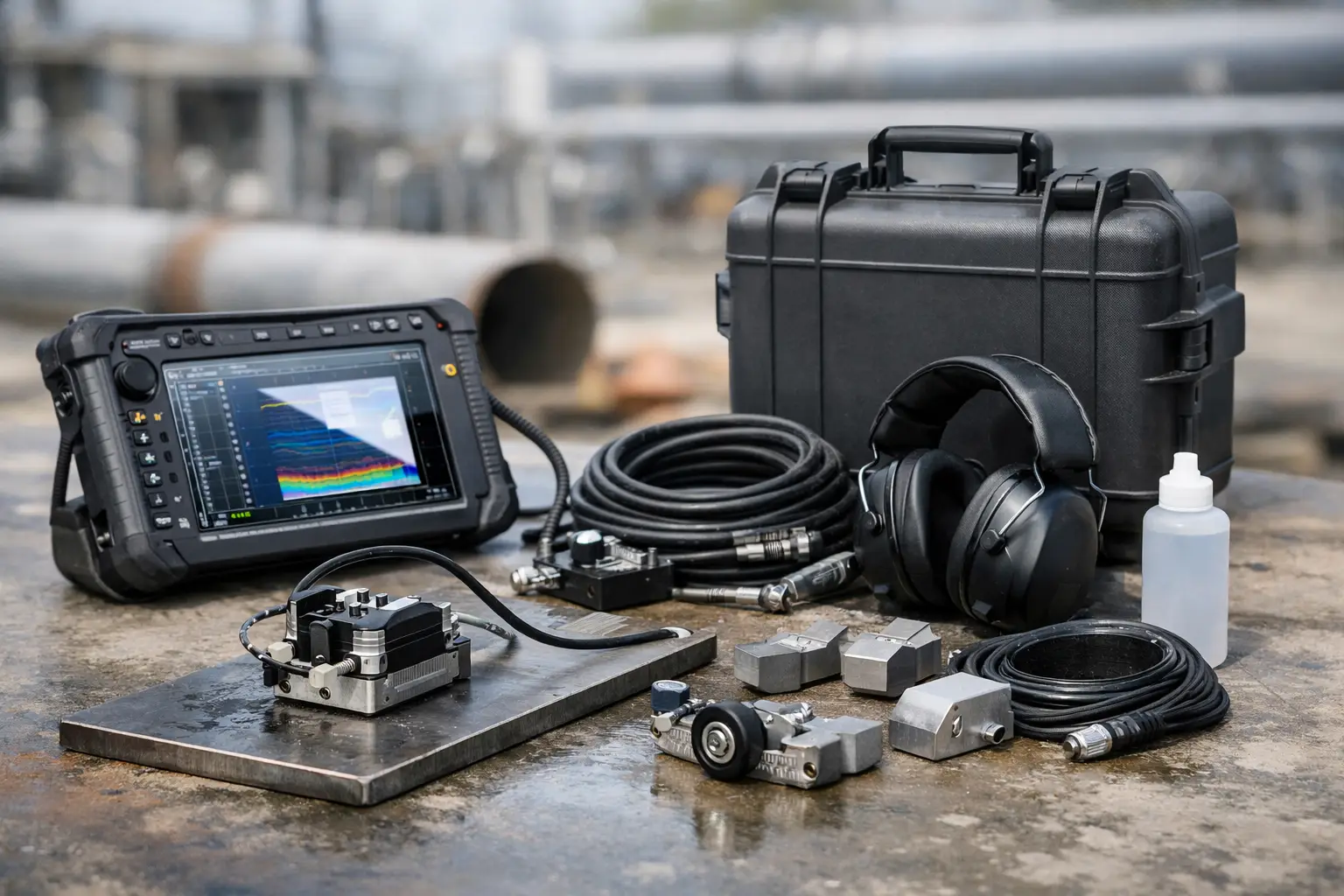

A scanner usually gets blamed when a weld scan slows down, slips, or needs to be run again. In the field, though, the real problem is often the accessory setup. The best PAUT scanner accessories are the parts that keep probe alignment consistent, maintain encoder confidence, and let you move from one inspection task to the next without rebuilding half the rig.
That matters more than most teams admit. If you are covering circumferential welds in the morning and switching to corrosion mapping or a different pipe diameter that afternoon, small hardware choices decide whether the day runs cleanly or turns into dead time. Accessories are not extras for show. They are what make a scanner practical.
What makes the best PAUT scanner accessories worth buying
For working NDT crews, a good accessory does one of three things. It improves data quality, reduces setup time, or extends the range of jobs a scanner can handle. The better ones do all three.
That means the best accessory is not always the most complex one. A simple wheel change can matter more than a fancy bracket if it stops slippage on coated pipe. Likewise, a well-designed wedge holder can save more time than a new scanner frame if it lets you keep a repeatable probe position across multiple welds.
There is also a cost argument here. Plenty of inspection businesses still try to force one scanner platform to cover every application. The result is constant reconfiguration, more wear on key parts, and a queue of jobs waiting on the same hardware. Accessories should reduce that bottleneck, not add to it.
1. Encoders that give reliable feedback in real conditions
If the encoder is inconsistent, the rest of the scan is on shaky ground. Reliable position feedback is one of the first things to get right, especially on rougher surfaces, painted components, or field conditions where ideal contact is not guaranteed.
A good encoder setup needs stable mounting, clean cable management and enough mechanical confidence that you are not second-guessing data because of wheel bounce or intermittent contact. In practice, that often means matching the encoder style and wheel material to the surface rather than treating encoder choice as universal.
For manual scanning, this is one accessory area where cheaping out usually costs more later. Lost confidence in index or scan position quickly turns into repeat work.
2. Wheel kits for different surfaces and diameters
Wheels are often treated as consumables, but they are also one of the most useful ways to tune a scanner for the job. The right wheel set changes stability, tracking and contact pressure. The wrong set can make an otherwise capable scanner feel awkward and unreliable.
For pipe work, diameter changes matter. For painted or scaled surfaces, grip matters. For corrosion mapping, smooth travel matters. The best PAUT scanner accessories usually include wheel options that let technicians adapt the scanner without a full redesign.
This is one of those areas where modularity pays off immediately. If changing wheel geometry gets you onto a new pipe size or improves travel on a difficult coating, you have solved a real field problem with a small hardware change.
3. Probe holders that maintain alignment, not just attachment
A probe holder should do more than clamp a probe in place. It should preserve beam position, maintain pressure, and hold alignment through the full scan path. That is particularly important in weld inspection, where small shifts in angle or offset can affect coverage and repeatability.
The trade-off is adjustability versus rigidity. Highly adjustable holders are useful when you need to accommodate different probes and wedges, but too much freedom in the mechanism can introduce movement where you do not want it. A more fixed holder can be excellent for repeat jobs, though less flexible if your work changes day to day.
The practical answer is to choose holders that can be adjusted quickly but lock down firmly. That gives you enough versatility without turning setup into a fiddle every time the scanner comes out of the case.
4. Wedge accessories that suit the application
Wedges tend to get discussed in terms of acoustics, which is fair enough, but mechanically they also need to work with the scanner. A wedge accessory that positions the probe cleanly, protects the wedge, and keeps motion predictable can make a big difference to scan consistency.
This is especially relevant when switching between PAUT and ToFD setups or when managing multiple weld procedures. If the wedge mount is awkward, slow to change, or prone to small positioning errors, the whole inspection takes a hit.
The better setups are the ones that let technicians swap or adjust wedge-related hardware with minimal downtime while keeping alignment repeatable. That is not glamorous, but it is exactly what keeps jobs moving.
5. Magnetic or chain-based guidance for pipe scanning
Pipe scanning accessories need to match the job environment. Magnetic guidance can be quick and effective on suitable ferrous surfaces, but it is not the answer for every situation. Surface condition, coating, geometry and access all affect whether magnets behave as expected.
Chain-based systems, on the other hand, can offer more universal mechanical control across varying diameters and conditions, though they may take longer to fit and tension correctly. Neither approach is automatically better. It depends on the material, the diameter range and how often you need to move between scan locations.
For contractors handling mixed work, having both options available is often more practical than trying to force one method onto every pipe.
6. Cable management that stops avoidable scan interruptions
Cable routing is rarely the first thing people mention, yet poor cable management causes constant irritation. Snagging, drag and cable-induced probe movement can all affect scan quality and operator control.
A decent cable management accessory does not need to be elaborate. It just needs to keep the lead path tidy, reduce pull on the probe assembly and stop the cable catching as the scanner moves. On vertical or awkward-access jobs, this becomes even more important.
It is a small upgrade, but one that often improves operator comfort and scan consistency at the same time.
7. Corrosion mapping attachments for broader use
One of the quickest ways to get more value from a scanner platform is to add hardware that supports corrosion work. If a scanner can move from weld inspection into corrosion mapping with the right accessory set, it becomes far more useful to a small or mid-sized inspection business.
The key is not to compromise both tasks. A scanner that does welds well but only handles corrosion mapping poorly is not truly versatile. The best add-ons are the ones that adapt the mechanical setup to suit raster or encoded corrosion scans without turning the platform into a compromise piece of kit.
This is where purpose-built accessories often outperform generic add-ons. They are designed around real use cases, not just catalogue compatibility.
8. Spare mounting hardware that keeps crews working
This one is less exciting, but it saves jobs. Spare clamps, brackets, fasteners and mounting plates can be the difference between getting a scan done and losing half a shift over a missing or damaged part.
Field kits take knocks. Parts go missing. Someone borrows a component and it never comes back to the right case. Keeping critical mounting hardware as a planned accessory rather than an afterthought is simply good operational practice.
Experienced crews already know this. The problem is that many businesses still buy scanner hardware as if it will live a clean life on a bench. It will not.
9. Transport and storage accessories that protect calibration confidence
Accessories are only useful if they arrive on site in working condition. Transport protection matters because scanners, encoders, wedges and holders all suffer when they are thrown loosely into a toolbox or the back of a ute.
A proper storage arrangement helps preserve setup repeatability as much as it protects the hardware. When each component has its place, crews can deploy faster, inspect missing parts earlier and reduce damage from transport. That makes a difference over months of field work, not just on one job.
Choosing accessories for your actual workflow
The best PAUT scanner accessories are the ones that remove friction from the jobs you do most often. If your work is mostly pipe welds across changing diameters, wheel options and guidance systems should sit high on the list. If you are doing repeated encoded weld scans with strict setup consistency, probe holders and wedge positioning hardware matter more. If your business is trying to stretch scanner use across multiple service lines, corrosion mapping attachments and spare modular hardware become hard to ignore.
It is also worth being honest about what is causing delay now. If technicians are rebuilding a scanner every second day, that is not just an inconvenience. It is a workflow problem. In many cases, adding the right accessories - or setting up dedicated configurations - is a more sensible fix than putting more strain on one premium scanner platform.
That is the practical thinking behind modular inspection hardware. PAUT.Tech has built its range around that same reality: gear that suits the task, reduces unnecessary rebuild time and gives crews more ways to stay productive without overspending on equipment they do not need.
A good accessory earns its place when nobody talks about it on site because the scanner just works, the data is clean, and the crew gets onto the next job without wasting the afternoon.