
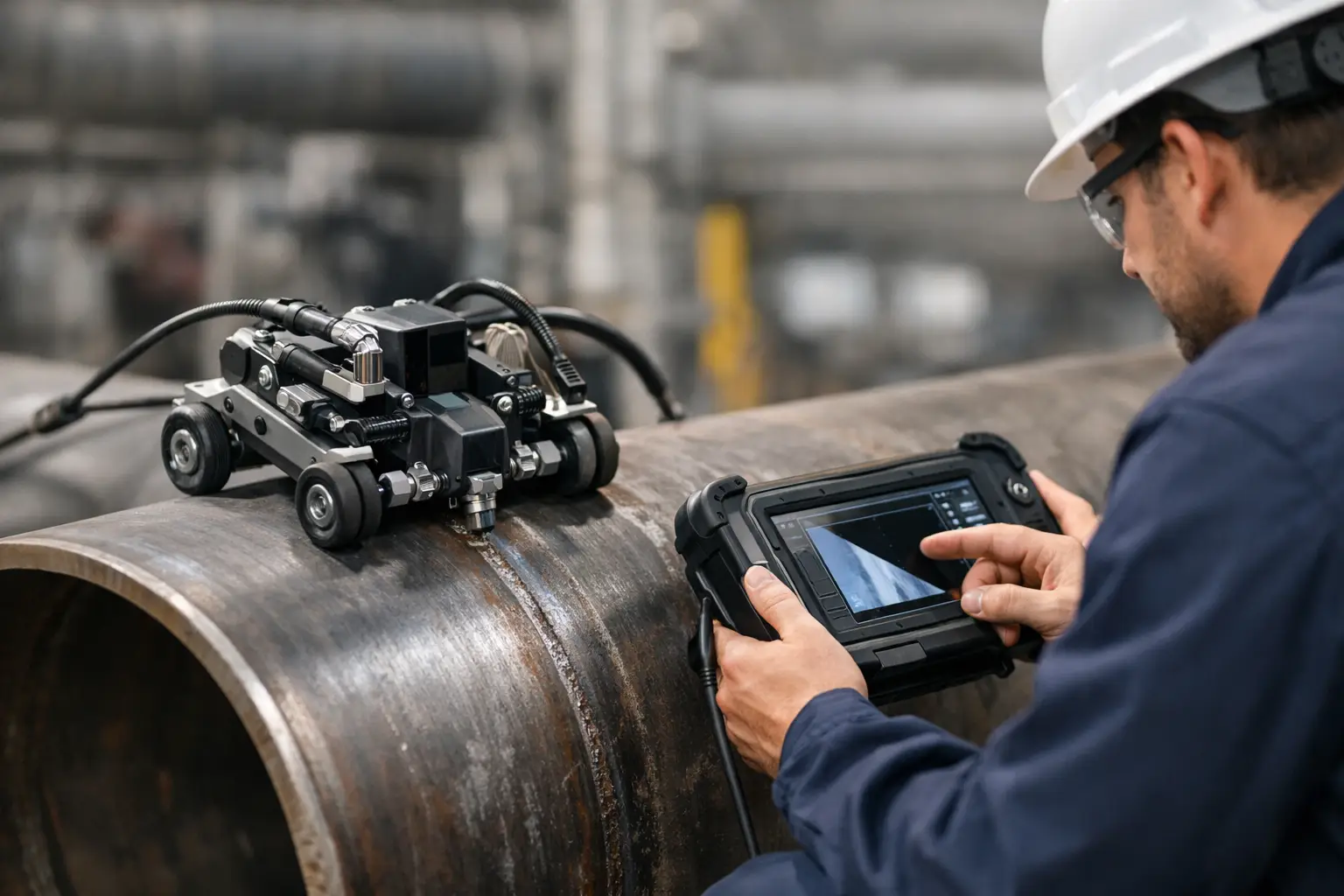

When a weld crew is waiting, access is tight, and the shutdown window is shrinking by the hour, scanner choice stops being a catalogue exercise. A portable weld scanner guide matters because the wrong setup costs time twice - once in slow deployment, and again when you have to rebuild it for the next job.
For field NDT, portability is not just about weight. It is about how quickly a scanner can be carried to location, set on the weld, matched to the inspection method, and kept running without turning one bit of hardware into a permanent workshop project. That is the practical test.
What a portable weld scanner guide should actually help you decide
A useful guide should not pretend there is one scanner for every weld. Most technicians already know that claim falls apart in real work. Circumferential pipe welds, longitudinal seams, nozzle welds, small-bore lines, plate butt welds, and access-constrained fabrication jobs all ask different things from the hardware.
The better question is this: what scanner configuration gets the data you need, with the least setup friction and the least compromise on probe stability, encoder performance, and repeatability? That is where portable systems earn their keep.
In practice, portability sits on three factors. The first is physical handling - size, weight, and how awkward the unit is on ladders, scaffolds, elevated work platforms, or around insulation breaks. The second is modularity - whether the scanner can be adapted without a full strip-down every time the weld geometry changes. The third is job suitability - whether the scanner was built for weld inspection work rather than forced into it.
Portable weld scanner guide: start with the inspection job
Before comparing scanner frames, wheels, magnets, or chain options, start with the job itself. If the application is PAUT on a carbon steel pipe weld with decent access, your priorities may be stable circumferential travel, reliable encoding, and enough adjustment to accommodate wedge spacing and probe offset. If it is a ToFD setup on a larger diameter pipe, you may care more about consistent probe separation and clean, repeatable movement over the cap profile.
For plate welds or vessel seams, the problem changes again. Magnetic hold may be straightforward, but carriage alignment and probe support become more important than flexibility around a curved surface. On smaller diameters, every millimetre of frame bulk starts to matter. A scanner that looks adaptable on paper can become clumsy fast when there is no room for hands, cables, and wedges.
That is why experienced teams usually buy around recurring work, not edge-case work. If most of your workload is pipe welds in a defined diameter range, a purpose-built portable scanner will often outperform a supposedly universal scanner that needs constant rebuilding. Universal hardware sounds efficient until you lose half a day changing it over.
The trade-off between one scanner and several job-specific units
A lot of inspection businesses start with the idea that one premium scanner should cover everything. On paper, that looks economical. In the field, it often creates a bottleneck.
One scanner gets tied up on a job, another crew needs it, and suddenly your flexibility disappears. Or the unit comes back from one task and has to be reconfigured for another, which adds workshop time, increases wear on adjustment points, and creates more opportunities for setup error. None of that improves billable output.
There is a strong case for having multiple portable scanners that are each built around a common inspection need. That does not mean buying unnecessary hardware. It means reducing rebuild time and protecting uptime. For many service companies, two or three fit-for-purpose scanners deliver more operational value than one expensive platform that is always in pieces.
That practical, task-specific approach is where modular scanner systems make sense. A technician does not need luxury hardware. They need a scanner that can be deployed quickly, tracks properly, and survives regular field use without becoming precious.
Key features that matter in a portable weld scanner guide
Portability should be judged under working conditions, not on a bench. A scanner can be light but still frustrating if cable routing is messy, encoder mounting is vulnerable, or probe holders need excessive adjustment to get a clean setup.
Encoder reliability is one of the first things to check. If scan position drifts or the encoder loses confidence on uneven surfaces, the rest of the system is already compromised. Good portability includes protecting the encoder arrangement from knocks and keeping wheel or drive contact consistent over weld caps, coatings, and minor surface variation.
Probe and wedge accommodation matters just as much. PAUT and ToFD setups vary, and a scanner should not force awkward compromises in probe position just because the frame lacks sensible adjustment. Fine adjustment is useful, but there is a line where too many moving parts slow the setup down. For field teams, simple and repeatable usually beats highly configurable.
Material contact is another practical point. Magnetic scanners work well on ferrous surfaces, but not every job gives you a clean, ideal surface. Chain-driven or band-style options may suit some pipe applications better, especially when access or geometry rules out a broad magnetic footprint. It depends on surface condition, diameter, orientation, and whether the scanner needs to travel vertically, overhead, or around obstructions.
Weight still matters, but balance matters more. A portable unit should be easy to carry and steady to place, not just light enough to look good in a spec sheet. If the scanner feels awkward on a live site, technicians will remember that long after they forget the listed mass.
Choosing for PAUT, ToFD, or combined work
Not every weld scanner handles mixed methods equally well. Some are clearly better suited to PAUT where one probe group and a compact carriage can do the job neatly. Others are more practical for ToFD where maintaining probe separation and alignment is central to data quality.
Combined PAUT and ToFD work introduces another layer. The scanner needs enough flexibility to mount both methods without turning setup into an engineering exercise on site. If you regularly run combined inspections, it is worth selecting hardware around that requirement from the start rather than trying to retrofit every time.
This is also where accessories matter. Encoders, wedge holders, adaptor plates, and cable management are not add-ons in the real sense. They are part of whether a scanner is actually usable on your jobs. A cheap frame that needs constant improvisation is not genuinely cost-effective.
Cost control is part of scanner selection
Inspection businesses do not just buy scanners for technical capability. They buy them to protect margin, increase deployment capacity, and avoid downtime. That is why a portable weld scanner guide should include cost in a practical sense, not just purchase price.
The true cost of a scanner includes rebuild time, technician frustration, delayed mobilisation, component wear, and the number of jobs you cannot run because the hardware is already committed elsewhere. Expensive systems often justify themselves on versatility, but if that versatility is rarely used, you are carrying cost without much return.
For many owner-operators and small to mid-sized NDT teams, affordable, modular scanners make more sense than a single flagship unit. The aim is not to have the most elaborate setup in the workshop. It is to have the right setup available when the client needs the inspection done.
PAUT.Tech has built much of its approach around that reality - practical scanner hardware that can be deployed across common PAUT and ToFD jobs without forcing teams into one costly, all-purpose platform.
What to check before you buy
Ask how often the scanner will be reconfigured, what weld types make up most of your workload, and whether your crews need multiple units in service at the same time. Look closely at probe mounting range, encoder protection, surface holding method, and how easily the scanner can be carried and set up by one technician.
Then be honest about your operating environment. Workshop demos are tidy. Shutdowns, refineries, fabrication yards, and remote sites are not. A good portable scanner should make those conditions easier to manage, not add another layer of complexity.
The best choice is usually the one that matches your repeat work, travels well, and can be put into service without fuss. If a scanner saves twenty minutes on every setup and avoids constant rebuilds, that gain shows up everywhere - utilisation, labour, equipment life, and client response time.
Field inspection rarely rewards the fanciest gear. It rewards hardware that is ready when you are, stable on the weld, and practical enough to keep moving job after job. Buy for that reality, and your scanner will earn its place long after the sales pitch is forgotten.